

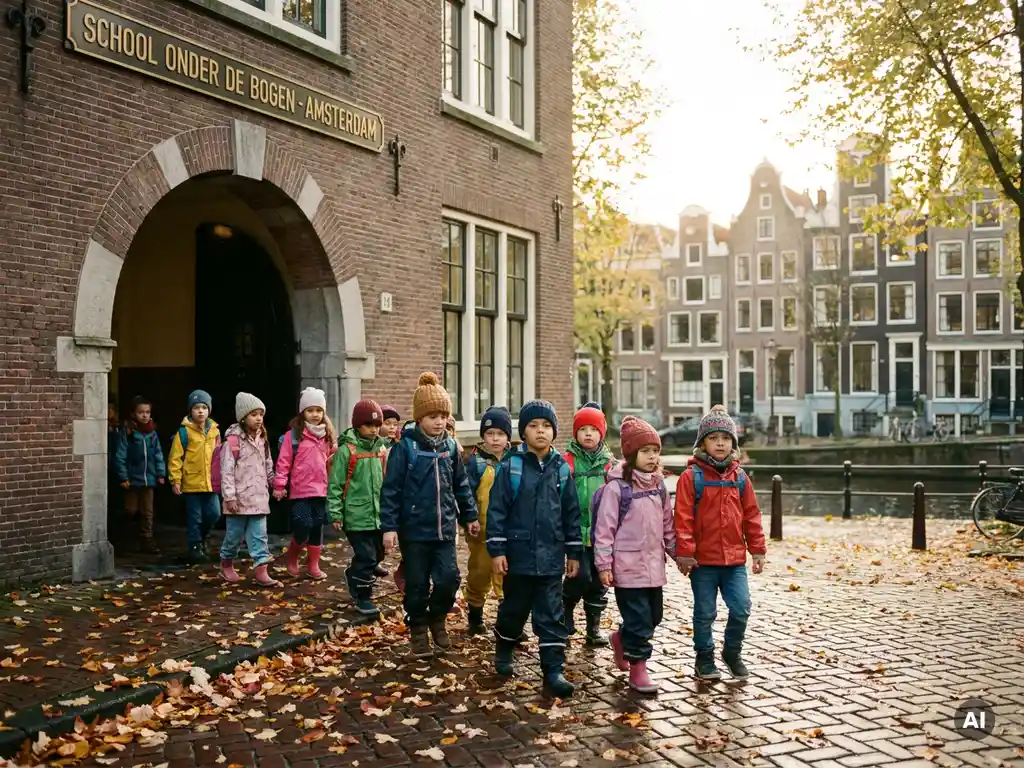
Amsterdam is home to a wide range of international schools offering high-quality education in English and other languages, making it one of the most well-served cities in Europe for expat families. The city has more than a dozen established international schools, catering to children from nursery age through to secondary school graduation. Whether your family is relocating for work, a secondment, or a longer-term move, understanding the educational landscape is an important part of settling in successfully. The sections below address the most common questions families ask when planning their move to the Netherlands.
Which international schools in Amsterdam offer the IB curriculum?
Several international schools in Amsterdam offer the International Baccalaureate (IB) curriculum, making it one of the most widely available programmes for expat families in the city. The IB is particularly valued for its portability, children can transfer between IB schools worldwide without significant disruption to their studies. Schools offering IB programmes in Amsterdam include the Amsterdam International Community School (AICS), the British School of Amsterdam, and the International School of Amsterdam (ISA), among others.
The IB framework is structured across three programmes depending on age:
- Primary Years Programme (PYP): for children aged 3 to 12
- Middle Years Programme (MYP): for students aged 11 to 16
- Diploma Programme (DP): for students aged 16 to 19, leading to the internationally recognised IB Diploma
The IB Diploma is accepted by universities across the world, including institutions in the United States, the United Kingdom, and the Netherlands. For families who anticipate further international moves, choosing an IB school provides continuity and reduces the risk of curriculum gaps when transferring between countries.
What other curricula are available at Amsterdam international schools?
Beyond the IB, Amsterdam international schools offer a range of curricula to suit different national backgrounds and educational preferences. The most common alternatives are the British curriculum (leading to IGCSEs and A-Levels), the American curriculum, and the Dutch bilingual system. Some schools also offer the European Baccalaureate or national programmes from Germany, France, and Japan.
Key options include:
- British curriculum: The British School of Amsterdam follows the English National Curriculum, preparing students for IGCSE and A-Level qualifications recognised globally.
- American curriculum: Some schools offer an American-style programme leading to a High School Diploma, which is well suited to families planning to return to the United States.
- Dutch bilingual education: Several Dutch schools offer bilingual (Dutch-English) streams, which can be a strong option for families planning a longer stay and wishing to integrate more fully into Dutch society.
- French curriculum: The Lycée Français Vincent van Gogh serves French-speaking families and follows the French national curriculum, leading to the Baccalauréat.
Choosing the right curriculum depends on your child’s current educational stage, your family’s likely next destination, and whether you intend to transition your child into the Dutch national system at any point.
How much do international schools in Amsterdam cost?
International school fees in Amsterdam are substantial, typically ranging from approximately €10,000 to €25,000 per year per child, depending on the school and year group. Fees are generally higher for secondary-age students than for primary-age children. Most schools also charge a one-off registration or enrolment fee, and some levy an annual capital or facility contribution on top of tuition.
For many expat families, school fees are partially or fully covered by their employer as part of a relocation package. Under Dutch tax rules, employers may reimburse international school fees as a tax-free benefit, provided the school meets specific criteria. The school must offer education based on a foreign curriculum, and it must be primarily intended for children of expatriate workers. This reimbursement falls within the broader category of extraterritorial costs that can be compensated under the Dutch expat scheme.
It is worth noting that the expat scheme, formerly known as the 30% ruling, allows qualifying employees to receive a tax-free allowance to offset the additional costs of relocating to the Netherlands, which can include school fees alongside housing and other living expenses. Families should confirm the specifics of their employer’s policy and any applicable tax arrangements before committing to a school.
What is the admissions process for international schools in Amsterdam?
The admissions process for international schools in Amsterdam varies by institution, but most follow a broadly similar sequence: an initial enquiry, submission of documentation, an assessment or interview, and a formal offer of a place. Popular schools can have waiting lists, particularly for certain year groups, so families are strongly advised to begin the process as early as possible, ideally six to twelve months before the intended start date.
The typical steps in the admissions process are as follows:
- Initial enquiry: Contact the school’s admissions office to confirm availability and request an information pack or open day invitation.
- Application submission: Complete the school’s application form and submit supporting documents, which commonly include previous school reports, a copy of the child’s passport, proof of address or intended address in Amsterdam, and any relevant medical or learning support information.
- Assessment: Some schools conduct an informal assessment or interview to gauge the child’s current level and ensure appropriate year group placement.
- Offer and acceptance: If a place is available, the school will issue a formal offer. Acceptance typically requires payment of a registration fee and, in some cases, a deposit.
- Enrolment: Final enrolment is completed once the family has confirmed their move and provided proof of residence in the Netherlands.
Families relocating for work should coordinate their school application timeline with their employer’s relocation support, as some companies offer dedicated assistance with school placement as part of their international mobility services.
Where in Amsterdam are international schools located?
International schools in Amsterdam are spread across several districts, with a concentration in the southern and south-eastern parts of the city. The Zuidas business district and the areas around Amstelveen, a municipality directly adjacent to Amsterdam, are particularly well served, reflecting the high concentration of international companies and expat residents in those areas.
Amstelveen itself is home to several well-established international schools and is a popular residential choice for expat families precisely because of its proximity to both Amsterdam and Schiphol Airport. The International School of Amsterdam, for example, is located in Amstelveen. Other schools are situated within Amsterdam’s southern districts, including areas such as Buitenveldert and Oud-Zuid, which are accessible by public transport from most parts of the city.
When choosing where to live, many expat families consider the distance to their preferred school. Amsterdam’s public transport network is efficient, but younger children in particular benefit from shorter commutes. Families considering areas further from the city centre, such as Haarlem, Diemen, or Almere, should check transport links and journey times to their shortlisted schools before finalising their housing choice.
What legal and administrative steps are needed before enrolling in an Amsterdam school?
Before enrolling a child in an international school in Amsterdam, families must complete several legal and administrative steps related to their residency status in the Netherlands. The specific requirements depend on the family’s nationality, the purpose of their stay, and the duration of their relocation.
The key steps typically include:
- Registration with the municipality (gemeente): All residents of the Netherlands must register at their local municipality. In Amsterdam, this is done through the City of Amsterdam. Registration is required before many other administrative processes can be completed.
- BSN (Burgerservicenummer): A citizen service number is required for virtually all official interactions in the Netherlands, including school enrolment, healthcare, and banking. It is issued upon municipal registration.
- Residence permit (if applicable): Non-EU nationals require a valid residence permit to live and work in the Netherlands. Employers of highly skilled migrants typically initiate this process through the IND (Immigration and Naturalisation Service). The residence permit must be in place before children can be formally enrolled in school.
- Proof of address: Schools require confirmation of a residential address in the Netherlands. Families who have not yet secured permanent housing may need to provide a temporary address or a letter from their employer confirming their intended place of residence.
- Translation of documents: Previous school records, birth certificates, and other official documents may need to be translated into English or Dutch, and in some cases officially apostilled.
Families who are new to the Netherlands and navigating these requirements simultaneously, residence permits, housing, school enrolment, tax registration, often find that having access to reliable legal guidance makes the process considerably more manageable. The costs associated with obtaining official documents, such as residence permits and visas, may qualify as extraterritorial costs reimbursable under the expat scheme, depending on the employer’s arrangements.
How Russell Advocaten Can Help Expat Families in Amsterdam
Relocating to the Netherlands involves far more than finding the right school. The legal and administrative landscape, from residence permits and housing contracts to tax arrangements and employment terms, can be complex, particularly for families arriving from outside the EU.
Russell Advocaten is an internationally oriented law firm based in Amsterdam, with long-standing experience advising expats on the full range of legal matters that arise when moving to the Netherlands. The firm’s lawyers communicate fluently in English, German, and Dutch, which is a practical advantage for international clients navigating Dutch legal and administrative processes. Russell Advocaten is also an official partner of IN Amsterdam, the expat centre of the Municipality of Amsterdam.
The firm’s services for expat families and their employers include:
- Advice on the expat scheme (formerly the 30% ruling) and eligibility conditions
- Guidance on residence and work permits, including applications for highly skilled migrants
- Legal support with rental agreements, including the diplomat clause and other expat-specific provisions
- Assistance with setting up a business or branch in the Netherlands
- Employment law advice, including contract review and negotiation
- Family law matters, including family reunification and related immigration questions
Whether you are an employer relocating staff to Amsterdam or an individual planning your own move, professional legal advice at the outset can prevent costly complications later. Contact Russell Advocaten to discuss your situation with an experienced lawyer.
This information is general in nature and does not constitute legal advice for your specific situation. Please consult a lawyer at Russell Advocaten for advice tailored to your circumstances.
Veelgestelde vragen
How do I decide which curriculum is best for my child when moving to Amsterdam?
The most important factors to consider are your child’s current educational stage, your family’s likely next destination, and how long you plan to stay in the Netherlands. If further international moves are likely, the IB curriculum offers the greatest portability and continuity. If you plan to return to a specific country, choosing a curriculum aligned with that country’s system — such as the British, American, or French programme — will make the transition back much smoother. Speaking directly with admissions advisors at two or three shortlisted schools is a practical first step, as they can advise on year group placement and curriculum fit based on your child’s existing records.
What happens if my child doesn't speak English fluently — can they still attend an international school in Amsterdam?
Most international schools in Amsterdam offer English as an Additional Language (EAL) or English Language Learner (ELL) support programmes to help non-native speakers integrate into English-medium instruction. The level of support varies between schools, so it is worth asking specifically about EAL provision during the admissions process. Some schools also offer mother-tongue language support or bilingual programmes, which can ease the transition for younger children in particular. If English proficiency is a significant concern, Dutch bilingual schools may be worth considering as an alternative, as they offer a more gradual introduction to English alongside Dutch.
Can my child join an Amsterdam international school mid-year, or do admissions only happen at the start of the academic year?
Most international schools in Amsterdam accept mid-year admissions, which is a practical necessity given that expat families relocate throughout the year rather than only in September. However, mid-year places are subject to availability, and popular year groups may have waiting lists even for in-year entry. It is advisable to contact your shortlisted schools as soon as your relocation date is confirmed, even if it falls in the middle of a term. Schools are generally experienced at integrating new students mid-year and will typically conduct a brief assessment to ensure correct year group placement.
What if my employer's relocation package doesn't cover the full cost of international school fees?
If your employer’s package does not fully cover school fees, it is worth exploring whether any portion of the costs can be structured as a tax-free reimbursement under the Dutch expat scheme, which allows qualifying employees to receive compensation for extraterritorial costs including education expenses. You should also check whether your employer is open to negotiating the education allowance as part of your overall remuneration package, as this is a common point of discussion during international assignments. A tax or legal adviser with experience in Dutch expat arrangements can help you identify the most tax-efficient way to structure any employer contributions toward school fees.
Is it possible to transition my child from an international school into the Dutch national school system?
Yes, transitioning into the Dutch national system is possible, though it works best when children are younger and have more time to develop Dutch language proficiency. Dutch bilingual schools can serve as a useful bridge, as they teach in both Dutch and English and are often more accessible to expat children than fully Dutch-language schools. For older children, the transition is more challenging due to the language barrier and the structural differences between the Dutch secondary system and international curricula. Families considering this route are advised to discuss it with both the international school and prospective Dutch schools well in advance to plan the transition carefully.
How far in advance should I start the school search before our move to Amsterdam?
Ideally, you should begin researching and contacting schools six to twelve months before your intended start date, particularly if you are targeting popular schools or specific year groups that tend to fill up quickly. Starting early gives you time to attend open days, gather the required documentation, and work through the admissions process without pressure. If your timeline is shorter due to a sudden relocation, contact schools immediately and ask to be placed on a waiting list — places do become available, and schools are accustomed to working with families on tight timescales. Coordinating your school search with your employer’s relocation support team can also help streamline the process.
Do I need to have a permanent address in Amsterdam before I can apply to an international school?
Most international schools will accept applications before you have a confirmed permanent address in Amsterdam, though proof of a residential address in the Netherlands is typically required before final enrolment is completed. During the application stage, a letter from your employer confirming your relocation and intended place of residence is usually sufficient. If you arrive in temporary accommodation while searching for a permanent home, inform the school’s admissions team — they are familiar with this situation and can advise on what documentation to provide in the interim. Securing housing and completing your municipal registration (gemeente inschrijving) as early as possible will help avoid delays to your child’s start date.
Gerelateerde artikelen
- What neighbourhoods in Amsterdam are most popular with expats?
- Do you need a Dutch bank account to buy property in the Netherlands?
- When should an expat hire a lawyer in the Netherlands?
- Can you lose the 30% ruling if you change jobs in the Netherlands?
- How do you register as an expat in the Netherlands?
Deze inhoud is gegenereerd met behulp van AI en kan fouten bevatten.