

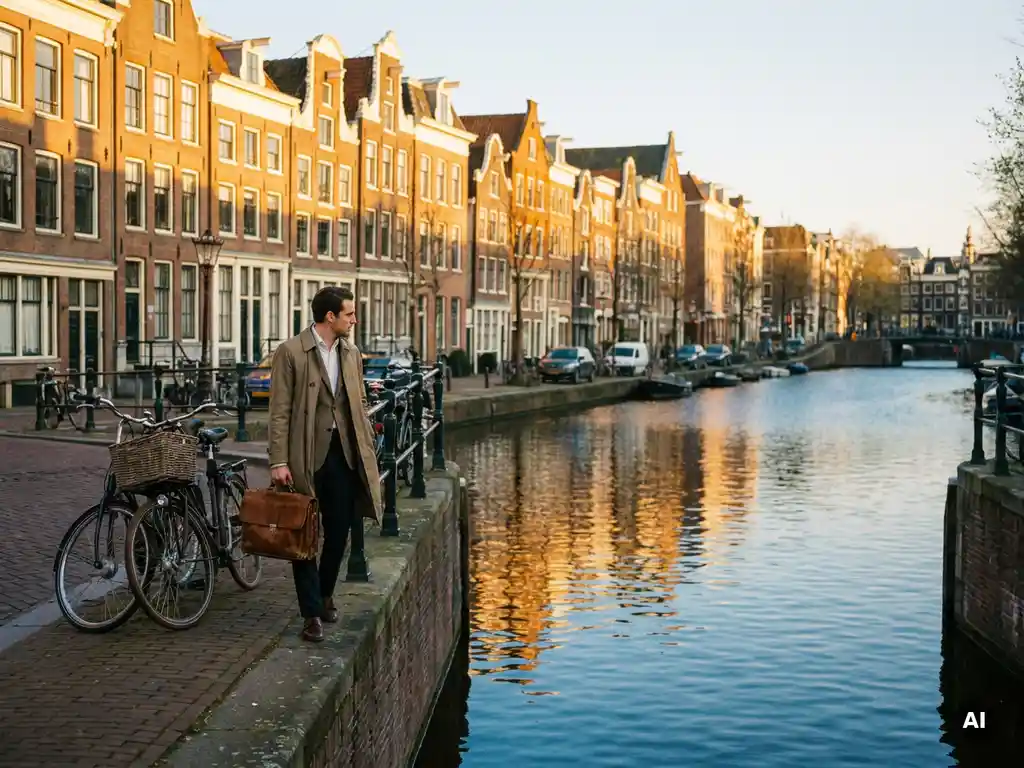
The most popular Amsterdam neighbourhoods with expats are Oud-Zuid, De Pijp, Zuidas, Jordaan, and the Amsterdam-Noord waterfront areas. These districts attract international professionals and families for different reasons, from proximity to multinational offices and international schools to vibrant social scenes and well-connected public transport links. The sections below address the most common questions expats ask when choosing where to live in Amsterdam.
Which Amsterdam neighbourhoods have the highest concentration of expats?
The highest concentrations of expats in Amsterdam are found in Oud-Zuid, Zuidas, De Pijp, Jordaan, and Amstelveen (just outside the city boundary). These areas combine good housing stock, English-speaking services, international school access, and strong transport links, the practical factors that matter most to those relocating to the Netherlands from abroad.
Oud-Zuid, which encompasses the Museum Quarter and Vondelpark, has long been the address of choice for senior international professionals and diplomatic staff. Its wide streets, spacious apartments, and proximity to the Rijksmuseum and Vondelpark give it a calm, established character that appeals to those accustomed to high-end urban living. Amstelveen, though technically a separate municipality, is closely associated with the expat community and is particularly popular with Japanese and American expatriates, partly due to its international schools and suburban feel.
Jordaan attracts younger international professionals drawn to its canal-side charm, independent restaurants, and creative atmosphere. Amsterdam-Noord, once overlooked, has grown significantly in appeal since the opening of the Noord-Zuidlijn metro and the development of the NDSM Wharf creative district.
What makes Zuidas attractive to international professionals?
Zuidas is Amsterdam’s central business district and the primary location for multinational corporations, international law firms, and financial institutions. For international professionals working in these sectors, living in or near Zuidas eliminates long commutes and places them within walking distance of colleagues, clients, and business amenities. It is the most professionally convenient neighbourhood for those working as expats in Amsterdam.
The district has developed rapidly over the past decade and now offers a range of modern apartment complexes, serviced residences, and high-specification rental properties. Its infrastructure is excellent: Amsterdam Zuid station connects directly to Schiphol Airport in under ten minutes and to Amsterdam Centraal in around the same time. For expats who travel frequently for work, this connectivity is a significant practical advantage.
Zuidas also benefits from proximity to Oud-Zuid and Vondelpark, meaning residents can access green space and the cultural amenities of the Museum Quarter within a short cycle or walk. The area’s newer residential developments tend to be purpose-built for professional occupants, with concierge services, gym facilities, and English-language property management as standard features.
How does De Pijp compare to Oud-Zuid for expat living?
De Pijp and Oud-Zuid represent two distinct expat lifestyles. De Pijp is lively, diverse, and socially active, centred around the Albert Cuyp Market and packed with international restaurants, independent cafés, and a young professional demographic. Oud-Zuid is quieter, more established, and generally more expensive, with larger apartments and a more formal residential character suited to senior professionals and families.
De Pijp has become one of Amsterdam’s most sought-after neighbourhoods for expats in their late twenties and thirties. The area is well served by the Noord-Zuidlijn, making it straightforward to reach both Zuidas and Amsterdam Centraal. Rental properties in De Pijp tend to be smaller than in Oud-Zuid, but the neighbourhood’s energy and social infrastructure make it a natural first choice for those arriving in Amsterdam without an established network.
Oud-Zuid, by contrast, suits those relocating with families or those who prioritise space, calm, and proximity to Vondelpark. The neighbourhood’s housing stock includes larger family apartments and a number of prestigious addresses along the main radial streets. English-speaking services, from GP practices to estate agents, are well established in both areas, though Oud-Zuid has a longer history of serving the diplomatic and senior corporate community.
What are the most expat-friendly areas for families with children?
The most expat-friendly areas for families with children in Amsterdam are Oud-Zuid, Amstelveen, and the Watergraafsmeer district. The primary factor driving these choices is access to international schools, followed by housing size, green space, and neighbourhood safety. Families relocating to the Netherlands typically prioritise schooling above all other considerations when selecting a neighbourhood.
Key considerations for families include:
- International school proximity: The Amsterdam International Community School (AICS) and the British School of Amsterdam are located in or near Oud-Zuid. Amstelveen hosts the Japanese School of Amsterdam and several other internationally oriented institutions.
- Housing size: Family-sized apartments and houses with gardens are more readily available in Amstelveen and the outer residential districts than in the city centre.
- Green space: Vondelpark (Oud-Zuid), Beatrixpark (Zuidas), and the broader green areas of Amstelveen offer safe outdoor environments for children.
- Community infrastructure: Established expat family networks, English-speaking paediatric care, and family-oriented social activities are concentrated in these areas.
Watergraafsmeer, further east, is an increasingly popular alternative for families seeking more space at lower rental costs, with good tram and metro connections to the city centre and access to Flevopark.
How much does it cost to rent in Amsterdam’s most popular expat areas?
Rental costs in Amsterdam’s most popular expat areas vary significantly by neighbourhood and property size. In 2026, monthly rents for a furnished two-bedroom apartment range from approximately €2,000 in outer districts to well above €3,500 in prime locations such as Oud-Zuid and Zuidas. The Amsterdam rental market remains highly competitive, and properties in desirable expat areas are typically let quickly.
As a general guide by neighbourhood:
- Oud-Zuid and Zuidas: The most expensive areas, with two-bedroom furnished apartments typically ranging from €2,800 to €4,000 or more per month depending on specification and exact location.
- De Pijp and Jordaan: Slightly more affordable, with comparable properties generally ranging from €2,200 to €3,200 per month, though smaller units are available at lower price points.
- Amstelveen: Generally more affordable than central Amsterdam for equivalent space, with family homes available in the €2,000 to €3,000 range, making it attractive for families prioritising size over central location.
- Amsterdam-Noord and Watergraafsmeer: The most accessible price points among popular expat areas, with two-bedroom apartments often available from €1,800 to €2,500 per month.
It is worth noting that the Dutch rental market has undergone regulatory changes in recent years, with new legislation affecting the mid-market rental segment. Prospective tenants are advised to seek current market information from a licensed estate agent and, where relevant, to obtain legal guidance on the terms of any tenancy agreement before signing.
What legal considerations apply when renting in Amsterdam as an expat?
When renting in Amsterdam as an expat, the most important legal considerations are the type of tenancy agreement, the applicability of Dutch rent protection legislation, the diplomat clause, and your registration obligations under Dutch law. Understanding these points before signing a lease can prevent significant difficulties later, as Dutch tenancy law is complex and differs considerably from the frameworks many expats are familiar with from their home countries.
The diplomat clause in rental agreements
The diplomat clause (diplomatenclausule) is a contractual provision that allows a landlord to terminate a tenancy if they need to return to the property themselves. It is frequently included in leases offered to expats on fixed-term assignments, as it provides landlords with a degree of flexibility that standard Dutch tenancy law would not otherwise permit. Expats should review whether this clause is present in their agreement and understand its implications for the security of their tenancy.
Rent regulation and tenant protection
Dutch law provides substantial protection to tenants in the social and mid-market rental segments. Since the introduction of the Affordable Rent Act (Wet betaalbare huur), a larger proportion of rental properties now fall within regulated price bands based on a points system. For expats renting in the private sector, it is important to establish whether the property falls within a regulated or liberalised category, as this affects both the rent that can lawfully be charged and the protections available if a dispute arises.
Additional legal considerations when renting in Amsterdam as an expat include:
- BRP registration: All residents in the Netherlands are required to register with the local municipality (gemeente) in the Personal Records Database (BRP). Failure to register can affect access to services and, for those on residence permits, compliance with immigration conditions.
- Deposit and service charges: Dutch law regulates the maximum deposit a landlord may request and imposes transparency requirements on service charge calculations.
- Lease termination: Notice periods and grounds for termination are strictly regulated. An expat tenant cannot simply be asked to leave without proper legal process, even on a fixed-term lease.
Given the complexity of Dutch tenancy law and the financial stakes involved in renting in Amsterdam, obtaining legal advice before entering into a lease agreement is a prudent step, particularly for those unfamiliar with the Dutch legal framework.
How Russell Advocaten assists expats with legal matters in Amsterdam
Russell Advocaten is an internationally oriented law firm based in Amsterdam, with more than 80 years of experience advising expats, international businesses, embassies, and diplomatic staff on a wide range of legal matters in the Netherlands. The firm’s lawyers communicate equally fluently in English, German, and Dutch, which makes them a practical and accessible point of contact for those navigating the Dutch legal system for the first time.
For expats relocating to Amsterdam, Russell Advocaten offers legal support across the areas that matter most:
- Real estate and tenancy law: Review and negotiation of rental agreements, advice on the diplomat clause, tenant rights, and dispute resolution with landlords.
- Setting up a business: Legal guidance on establishing a company in the Netherlands, including choice of legal entity, corporate governance, and compliance requirements.
- Employment and personnel matters: Advice on employment contracts, the expat scheme (formerly the 30% ruling), and Dutch employment law obligations for both employers and employees.
- Immigration and residence: General guidance on residence and work permit requirements in the context of the firm’s broader expat services.
- Contracts and liability: Drafting and reviewing commercial and personal contracts governed by Dutch law.
Russell Advocaten is an official partner of IN Amsterdam, the expat centre of the City of Amsterdam, and has been recommended by The Legal 500 for many years. The firm also operates an Embassy Desk for diplomatic staff and foreign government representatives.
If you are relocating to Amsterdam and would like legal guidance on your tenancy agreement, business setup, or any other matter covered in this article, contact Russell Advocaten to arrange a consultation with one of the firm’s experienced lawyers.
This information is general in nature and does not constitute legal advice for your specific situation; for advice tailored to your circumstances, please consult a lawyer at Russell Advocaten.
Veelgestelde vragen
How competitive is the Amsterdam rental market, and how quickly do I need to act when I find a suitable property?
The Amsterdam rental market, particularly in expat-popular areas like Oud-Zuid, De Pijp, and Zuidas, moves extremely fast — desirable properties are often let within days of listing. It is advisable to have your documentation ready in advance, including proof of income (typically three times the monthly rent), employer confirmation, and a valid ID or residence permit. Engaging a local estate agent (makelaar) who specialises in expat relocations can give you a significant advantage, as they often have access to properties before they are publicly listed.
Do I need a Dutch residence permit before I can sign a rental agreement in Amsterdam?
You do not necessarily need a residence permit in hand before signing a lease, but landlords and letting agents will typically require proof of your legal right to live and work in the Netherlands, such as a confirmed employment contract or a letter from your employer confirming your assignment. If your permit is still being processed, some landlords will accept a formal offer letter or a letter from the IND (Immigration and Naturalisation Service) confirming your application. It is worth clarifying this with the landlord or agent early in the process to avoid delays.
What are the most common mistakes expats make when choosing a neighbourhood in Amsterdam?
One of the most frequent mistakes is choosing a neighbourhood based on aesthetics or social appeal without factoring in the daily commute, school run, or proximity to key services — only to find the location impractical once settled. Another common error is underestimating how quickly neighbourhoods change in character: Amsterdam-Noord and Watergraafsmeer, for example, have transformed significantly in recent years and now offer strong value that many expats overlook in favour of more established areas. Taking the time to visit each shortlisted neighbourhood at different times of day, and speaking to other expats already living there, will give you a far more accurate picture than online research alone.
Is it better to rent furnished or unfurnished as an expat in Amsterdam, and what is typically included?
For most expats on fixed-term assignments, furnished rentals are the practical choice, as they eliminate the cost and complexity of purchasing and then selling furniture. In Amsterdam, furnished properties typically include white goods, kitchen equipment, beds, and basic living room furniture, though the quality and completeness varies considerably between landlords. ‘Upholstered’ (gestoffeerd) properties fall between the two — they include flooring and window coverings but not furniture — so it is important to clarify exactly what is included before signing. If you are planning a longer stay of three or more years, unfurnished rentals often offer better value and more flexibility to personalise your home.
How does the Dutch points-based rent regulation system (WWS) affect expats renting in the private sector?
The Dutch Woningwaarderingsstelsel (WWS), or housing points system, assigns a score to rental properties based on factors such as size, energy label, and facilities, and this score determines whether a property falls within the regulated or liberalised (free market) segment. Since the introduction of the Affordable Rent Act, properties scoring below a certain threshold must be rented at or below a regulated maximum price, which can be significantly lower than what some landlords have historically charged. As an expat, this means that if you are renting a property that falls within the regulated segment, you may have grounds to challenge an above-limit rent at the Huurcommissie (Rent Tribunal) — making it well worth verifying the property’s WWS score before or shortly after signing your lease.
Can I negotiate the terms of a rental agreement in Amsterdam, or are contracts generally non-negotiable?
Rental agreements in Amsterdam are more negotiable than many expats expect, particularly in the higher-end private market where landlords are often open to discussion on rent-free periods, lease duration, break clauses, and the inclusion or exclusion of certain furnishings. However, certain terms — such as the maximum deposit and notice periods — are governed by Dutch law and cannot be contracted away to the tenant’s detriment. Having a lawyer review the agreement before signing is the most effective way to identify clauses that are unfavourable, legally questionable, or simply worth pushing back on.
What practical steps should I take in the first few weeks after moving into my Amsterdam rental property?
The most important first step is registering with your local gemeente (municipality) in the BRP (Personal Records Database), which is a legal requirement and a prerequisite for obtaining a BSN (citizen service number) — essential for opening a Dutch bank account, accessing healthcare, and complying with tax obligations. You should also document the condition of the property thoroughly at move-in with dated photographs and ensure a signed inspection report (opleveringsrapport) is agreed with the landlord, as this protects you against unjustified deposit deductions at the end of the tenancy. Finally, arrange Dutch health insurance (zorgverzekering) promptly, as you are legally required to hold it within four months of registering as a resident.
Gerelateerde artikelen
- How does Dutch employment law protect expats working in the Netherlands?
- What should expats check before signing a rental contract in the Netherlands?
- How do expats handle inheritance law in the Netherlands?
- What is the difference between social and private rental housing in the Netherlands?
- Is hiring an immigration lawyer worth it?
Deze inhoud is gegenereerd met behulp van AI en kan fouten bevatten.