

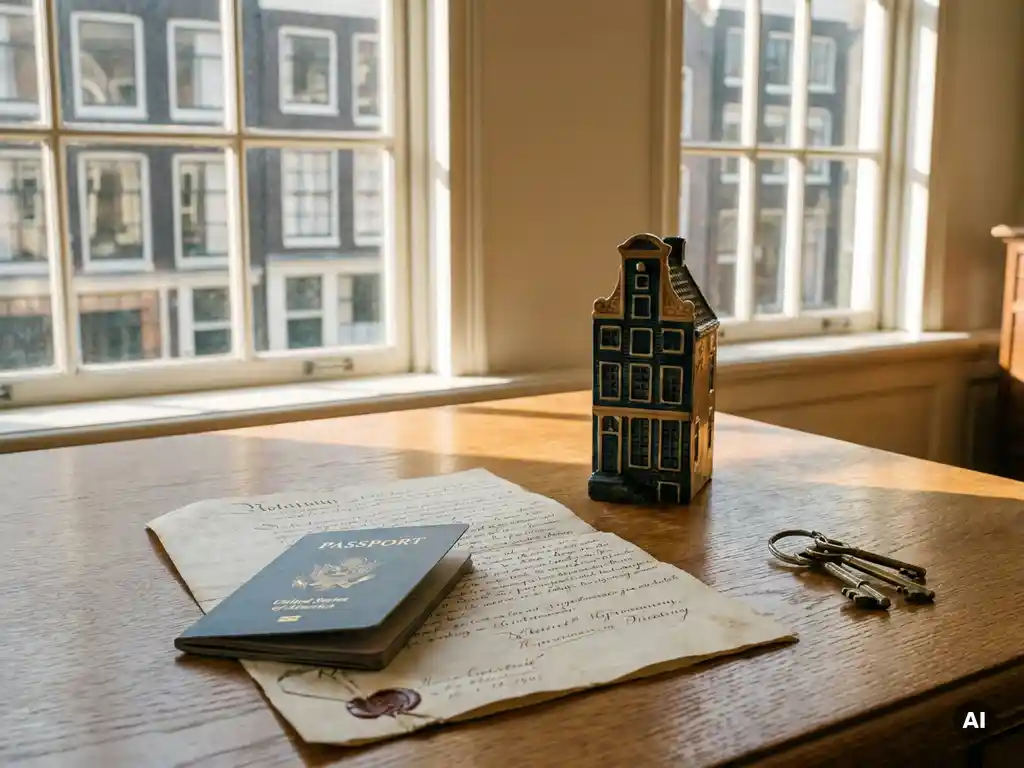
Yes, US citizens can buy a house in the Netherlands. There are no legal restrictions preventing foreign nationals, including Americans, from purchasing residential or commercial property in the country. Unlike some other European nations, the Netherlands imposes no nationality-based barriers to property ownership. That said, financing, taxation, and the practical mechanics of the transaction involve several important considerations that any US citizen should understand before proceeding.
The sections below address the most common questions that arise when an American looks to buy Dutch property, from mortgage eligibility and transfer taxes to the step-by-step purchase process and the specific complications that can affect US citizens in particular.
Do US citizens have the legal right to buy property in the Netherlands?
US citizens have the full legal right to purchase property in the Netherlands. Dutch law does not restrict property ownership on the basis of nationality or residency status. Whether you are living in the Netherlands, working here on a permit, or residing abroad entirely, you are legally entitled to buy residential or commercial real estate without requiring special government approval.
This openness to foreign buyers reflects the Netherlands’ broader commitment to the free movement of capital, a principle embedded in both Dutch law and EU treaty obligations. There is no requirement to obtain a residence permit before completing a property purchase, and there is no minimum period of prior residence that must be satisfied.
It is worth noting that owning property in the Netherlands does not automatically grant you the right to live there. Residency rights are governed separately by immigration law, and a US citizen who purchases a Dutch property but wishes to reside in it will still need to obtain the appropriate residence permit. Property ownership and the right of residence are entirely distinct legal matters under Dutch law.
Can a US citizen get a Dutch mortgage without a residence permit?
Obtaining a Dutch mortgage without a residence permit is possible in principle, but in practice it is significantly more difficult. Most Dutch lenders require applicants to be registered in the Netherlands and to demonstrate a stable, verifiable income sourced from the Netherlands. A US citizen living abroad without a Dutch employment contract or residence registration will face considerable obstacles when approaching mainstream Dutch banks.
Some specialist lenders and international mortgage brokers do offer products to non-resident buyers, but these typically come with stricter loan-to-value ratios, higher interest rates, and more extensive documentation requirements. Lenders will generally want to assess your income, existing liabilities, and creditworthiness, and a US credit history does not translate directly into the Dutch system.
For US citizens who are already living and working in the Netherlands under a valid residence permit, the situation is more straightforward. Expats in the Netherlands with a Dutch employment contract and a registered address can typically access standard mortgage products, though lenders may still apply additional scrutiny to income derived from abroad or structured in a non-standard way.
One relevant consideration for expats in Amsterdam and elsewhere in the Netherlands is the 30% ruling. If you qualify for this tax facility, your net income will be higher, which can improve your mortgage affordability assessment. However, not all lenders treat the 30% ruling benefit in the same way when calculating borrowing capacity, so it is advisable to seek independent financial advice tailored to your specific employment and residency situation.
What taxes and costs apply when buying property in the Netherlands?
When buying property in the Netherlands, a US citizen should budget for several mandatory taxes and transaction costs on top of the purchase price. The most significant is transfer tax (overdrachtsbelasting), which is charged as a percentage of the property’s purchase price. The applicable rate depends on the buyer’s circumstances and intended use of the property.
The key cost categories are:
- Transfer tax (overdrachtsbelasting): The standard rate for residential property purchased as a primary residence is 2%. For investment properties, second homes, or purchases by buyers who do not qualify for the reduced rate, the rate is 10.4%. First-time buyers under the age of 35 purchasing a property below a certain threshold may be exempt, but this exemption applies to residents of the Netherlands and is subject to specific conditions.
- Notary fees (notariskosten): The purchase of Dutch property must be completed before a civil-law notary (notaris). Notary fees vary but typically range from around €1,000 to €2,500 or more, depending on the complexity of the transaction and the notary’s rates.
- Estate agent fees (makelaarskosten): If you engage a buyer’s agent, their fee is typically 1% to 2% of the purchase price, plus VAT.
- Mortgage advisory and arrangement fees: If you obtain a Dutch mortgage, expect fees for mortgage advice, bank arrangement costs, and potentially a valuation report (taxatierapport).
- Land registry fees (kadasterkosten): A modest fee is charged by the Kadaster to register the transfer of ownership.
As a US citizen, there is an additional layer of complexity: the United States taxes its citizens on worldwide income and assets regardless of where they live. Property ownership in the Netherlands may generate reporting obligations in the US, particularly if the property produces rental income. This is a matter for a tax adviser with expertise in both Dutch and US tax law, and it falls outside the scope of general property purchase guidance.
What is the step-by-step process for a US citizen buying a Dutch property?
The process for buying property in the Netherlands follows a structured sequence that applies to all buyers, regardless of nationality. For a US citizen, the steps are as follows:
- Define your budget and financing: Before searching for properties, establish how much you can spend and whether you will finance the purchase through a Dutch mortgage, foreign financing, or personal funds. If you intend to apply for a Dutch mortgage, obtain a statement of borrowing capacity (hypotheekverklaring) from a lender or mortgage adviser.
- Engage a buyer’s agent (aankoopmakelaar): While not legally required, a buyer’s agent is strongly recommended, particularly for those unfamiliar with the Dutch market. They will assist with property searches, viewings, negotiations, and the technical inspection process.
- Make an offer and negotiate: Offers are typically made verbally or in writing through the agent. Negotiations may involve price, completion date, and any conditions (such as a financing clause or building inspection clause).
- Sign the preliminary purchase agreement (koopovereenkomst): Once terms are agreed, a preliminary contract is drawn up, usually by the seller’s notary. Buyers have a statutory three-day cooling-off period after signing. A deposit of 10% of the purchase price is typically required at this stage, or a bank guarantee in lieu.
- Conduct due diligence: Arrange a structural inspection (bouwkundige keuring) if this was a condition of the offer. Review the title deed, any ground lease (erfpacht) conditions, and the homeowners’ association (VvE) documentation, if applicable.
- Complete the transfer before the notary: On the agreed completion date, you sign the deed of transfer (akte van levering) and, if applicable, the mortgage deed (hypotheekakte) before the notary. The notary then registers the transfer with the Kadaster.
The entire process from accepted offer to completion typically takes six to eight weeks, though this can vary depending on the parties’ circumstances and the complexity of the transaction.
Are there any risks or complications specific to US citizens buying in the Netherlands?
There are several risks and complications that are particularly relevant for US citizens, beyond the general challenges that any foreign buyer might encounter in an unfamiliar property market.
The most significant is the US Foreign Account Tax Compliance Act (FATCA). Because the US taxes its citizens on worldwide income and assets, owning Dutch property creates potential reporting obligations to the Internal Revenue Service (IRS), especially if the property is rented out or if it is held through a Dutch legal entity. Dutch banks are also FATCA-compliant, which means that having a US connection can complicate the opening of a Dutch bank account, something you will need to complete a property purchase.
Ground lease (erfpacht) is another risk that catches many buyers off guard. Some Dutch properties, particularly in Amsterdam, are built on land that is leased from the municipality rather than owned outright. The terms of the ground lease, including periodic rent revisions, can significantly affect the long-term cost of ownership and the property’s resale value. Reviewing the erfpacht conditions carefully before committing is essential.
Currency risk is a practical concern if your income or savings are held in US dollars. Exchange rate fluctuations between the dollar and the euro can materially affect both your purchasing power and your ongoing mortgage repayment costs if you are servicing a euro-denominated loan from a dollar-based income.
Finally, if you are renting a house in the Netherlands as an expat and considering a transition to ownership, be aware that your residence status and income structure may affect both your mortgage eligibility and your tax position. The interaction between Dutch property ownership rules and your specific immigration and employment situation warrants careful review before you proceed.
Should a US citizen use a Dutch lawyer when buying property in the Netherlands?
Engaging a Dutch lawyer when buying property in the Netherlands as a US citizen is strongly advisable, even though it is not a legal requirement. The notary who oversees the transfer is a neutral party and does not represent either buyer or seller. A lawyer acting exclusively in your interest provides a different and complementary layer of protection.
A lawyer can review the preliminary purchase agreement before you sign it, identify unfavourable clauses, advise on the implications of any ground lease, and flag issues in the title documentation that might not be apparent to a buyer unfamiliar with Dutch property law. For a US citizen, a lawyer with experience in cross-border transactions can also help you understand the interaction between Dutch property law and your obligations under US law, though formal US tax advice should come from a qualified US tax professional.
Legal advice is particularly valuable in complex situations: purchases involving a legal entity, properties with planning complications, transactions where the seller is also a foreign national, or purchases made remotely without the buyer being physically present in the Netherlands. In all of these circumstances, having qualified legal representation reduces the risk of costly errors or misunderstandings.
How Russell Advocaten Can Help US Citizens Buying Property in the Netherlands
Russell Advocaten is an internationally oriented law firm based in Amsterdam, with decades of experience advising expats and international clients on legal matters in the Netherlands. The firm’s lawyers are fluent in English, Dutch, and German, which means you can discuss your situation clearly and without the risk of misunderstanding that can arise when working through translation.
For US citizens looking to buy property in the Netherlands, Russell Advocaten offers practical legal support across the key stages of the process, including:
- Reviewing and advising on preliminary purchase agreements (koopovereenkomsten) before you commit
- Identifying risks in title documentation, ground lease conditions, and homeowners’ association rules
- Advising on the legal structure of the purchase, particularly where a legal entity is involved
- Providing guidance on residence and immigration matters for those who intend to live in the property
- Supporting cross-border transactions where both Dutch and international legal considerations apply
Russell Advocaten is an official partner of IN Amsterdam, the expat centre of the City of Amsterdam, and has been recommended by The Legal 500 for many years. The firm’s breadth of expertise, spanning real estate, immigration, corporate law, and contracts, means that the various legal dimensions of your property purchase can be addressed by a single, trusted team.
If you are a US citizen considering buying property in the Netherlands and would like to discuss your situation with an experienced Dutch lawyer, contact Russell Advocaten to arrange an initial consultation.
This information is general in nature and does not constitute legal advice for your specific situation. Please consult a lawyer at Russell Advocaten for advice tailored to your circumstances.
Veelgestelde vragen
Can I buy Dutch property purely as an investment while living in the US, and what are the tax implications?
Yes, you can purchase Dutch property as a non-resident investment from the United States. However, this triggers tax obligations in both countries: in the Netherlands, rental income is subject to Dutch income tax, and the property will fall under Box 3 (wealth tax) in the Dutch system; in the US, the IRS requires you to report worldwide income, including foreign rental earnings. You should engage a tax adviser experienced in both Dutch and US tax law before proceeding, as the interaction between the two systems — including applicable tax treaties — can significantly affect your net return.
What is the biggest mistake US citizens make when buying property in the Netherlands?
The most common and costly mistake is signing the preliminary purchase agreement (koopovereenkomst) without having it reviewed by an independent lawyer first. Many buyers assume the notary is acting in their interest, but the notary is a neutral party — not your advocate. A second frequent error is underestimating the total purchase costs: transfer tax, notary fees, agent fees, and mortgage arrangement costs can add 5–8% on top of the purchase price, and failing to budget for these can derail a transaction at a late stage.
Will having a US passport make it harder to open a Dutch bank account, and do I need one to buy property?
Yes, having US citizenship can complicate opening a Dutch bank account due to FATCA compliance requirements — many Dutch banks are cautious about onboarding US persons because of the associated reporting obligations to the IRS. A Dutch bank account is effectively necessary to complete a property purchase, as it is used to transfer the deposit and settle the final payment through the notary. If mainstream banks decline your application, specialist banks or international financial institutions with Dutch operations may offer viable alternatives — this is worth exploring early in the process, well before you have an accepted offer.
What is erfpacht (ground lease) and how do I know if a property I'm considering is affected by it?
Erfpacht means the property sits on land leased from a third party — most commonly the Municipality of Amsterdam — rather than land that is owned outright. As a buyer, you inherit the ground lease obligations, which typically include periodic canon (rent) payments that can be revised significantly upward at the end of a lease period. You can identify whether a property is subject to erfpacht by checking the title deed (available via the Kadaster) or by asking your buyer’s agent or lawyer to review the listing documentation — this should always be done before making an offer, as unfavourable erfpacht terms can substantially affect the property’s value and your long-term costs.
Can I buy Dutch property remotely without being physically present in the Netherlands?
Yes, it is legally possible to complete a Dutch property purchase remotely by granting a power of attorney (volmacht) to a trusted representative — such as your lawyer — who can sign documents on your behalf before the notary. However, buying remotely carries elevated risk: you are making a major financial commitment without personally inspecting the property, attending negotiations, or being present at completion. If you must proceed remotely, engaging a buyer’s agent to conduct thorough viewings and a structural inspection on your behalf, alongside independent legal representation, is strongly recommended to mitigate those risks.
Does buying property in the Netherlands help me qualify for a Dutch residence permit or long-term visa?
No — property ownership alone does not entitle a US citizen to a Dutch residence permit or any right to live in the Netherlands. Residency rights are governed entirely separately under Dutch and EU immigration law. If your goal is to live in the property you purchase, you will need to qualify for a residence permit on an independent basis, such as through employment, self-employment, or the Dutch-American Friendship Treaty (DAFT), which allows US citizens to apply for a self-employment residence permit under a bilateral treaty. A lawyer with experience in both Dutch property and immigration law can help you understand which route is most appropriate for your situation.
How does the Dutch housing market work in practice, and is it competitive for foreign buyers?
The Dutch housing market — particularly in Amsterdam and other major cities — is highly competitive, with properties frequently selling above asking price and within days of listing. Foreign buyers are not disadvantaged legally, but may be at a practical disadvantage if they are unfamiliar with local bidding norms, moving quickly without local support, or unable to demonstrate mortgage pre-approval. Engaging an experienced buyer’s agent (aankoopmakelaar) who knows the local market is one of the most effective steps a US citizen can take to compete effectively, as they can advise on realistic offer levels, flag red flags, and move swiftly when the right property appears.
Gerelateerde artikelen
- How do expats build a social network when moving to Amsterdam?
- When can a landlord use the diplomat clause in the Netherlands?
- What is VAT registration and do expats need it in the Netherlands?
- What are the biggest challenges of moving to the Netherlands?
- Is the Netherlands good for expats?
Deze inhoud is gegenereerd met behulp van AI en kan fouten bevatten.