

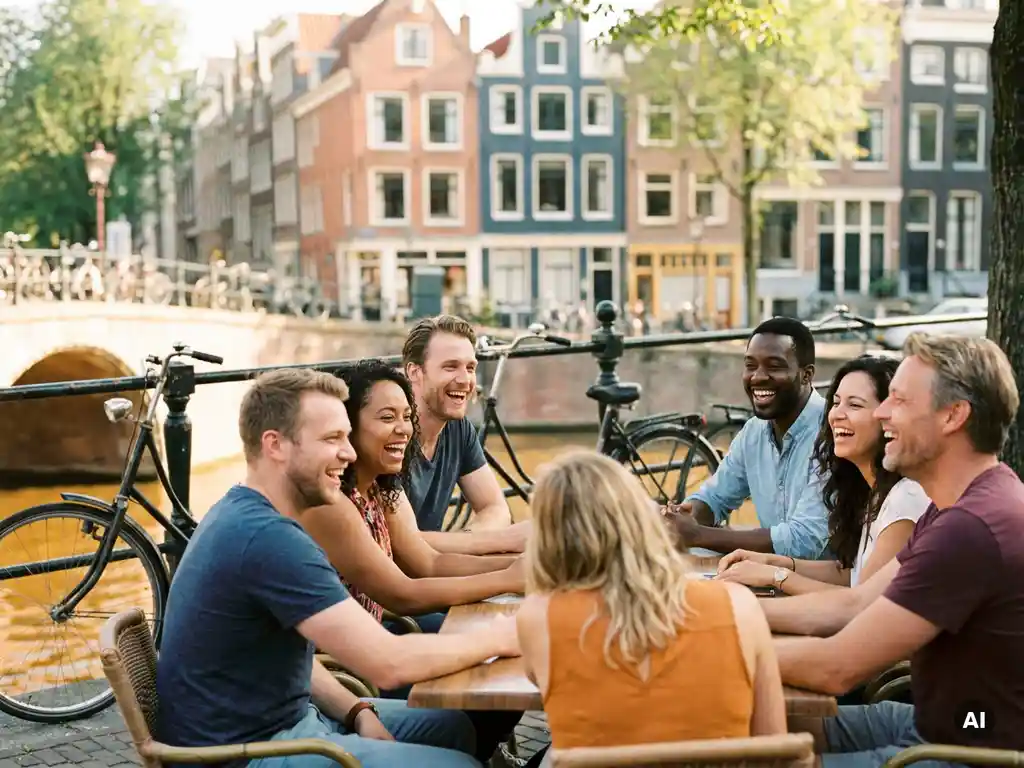
Expats in Amsterdam typically build a social network by combining structured activities, community groups, and workplace connections. The city has a well-established international community, and most newcomers find that a mix of organised events, online platforms, and consistent effort yields meaningful friendships within the first year. The sections below address the most common questions expats ask about social integration in Amsterdam.
Where do expats typically meet people in Amsterdam?
Expats in Amsterdam most commonly meet people through organised social events, sports clubs, cultural activities, and neighbourhood initiatives. The city’s international character means there is no shortage of settings designed specifically for newcomers, alongside everyday venues where locals and expats naturally mix.
Some of the most effective places to meet people include:
- Sports and fitness clubs – rowing clubs along the Amstel, cycling groups, and tennis associations regularly welcome new members and often have English-speaking participants.
- Cultural institutions – museums, galleries, and the many art events in the city attract internationally minded residents and provide natural conversation starters.
- Neighbourhood cafes and markets – Amsterdam’s district markets, such as those in the Jordaan or De Pijp, are informal but effective places to become a recognisable face in a local community.
- Volunteer organisations – contributing time to a local cause connects expats with both Dutch residents and other internationals who share similar values.
- Language exchange meetups – events where Dutch speakers practise English and English speakers practise Dutch are popular and create a natural, low-pressure social setting.
The key is consistency. Attending the same event or venue regularly tends to produce stronger connections than one-off outings, as familiarity builds trust over time.
What expat communities and clubs exist in Amsterdam?
Amsterdam has a broad range of expat communities and clubs catering to different nationalities, professions, interests, and life stages. These organisations actively facilitate introductions and social events, making them one of the most reliable entry points for newcomers to the city.
Well-established communities and clubs include:
- IN Amsterdam – the official expat centre of the City of Amsterdam, which provides practical support for internationals and organises networking events throughout the year.
- American Women’s Club of Amsterdam and similar nationally oriented clubs for British, German, French, and other expatriate communities.
- InterNations Amsterdam – one of the largest global expat networks, with a strong local chapter that hosts regular social gatherings across the city.
- Hash House Harriers – an international running and social club with an active Amsterdam chapter, popular among English-speaking expats.
- Professional associations – sector-specific groups in finance, technology, and the creative industries often hold English-language networking events.
- Religious and faith communities – several churches, mosques, and other places of worship in Amsterdam conduct services in English or other languages and provide a ready-made community.
Many of these organisations maintain active membership programmes and welcome newcomers explicitly, which removes much of the social awkwardness of joining an established group.
How do online platforms help expats connect in Amsterdam?
Online platforms play a significant role in helping expats find communities, discover events, and make initial connections before meeting in person. For many newcomers, digital networking is the first step towards building a social life in Amsterdam, particularly in the weeks immediately after arrival.
The most widely used platforms among expats in Amsterdam include:
- Meetup.com – hosts hundreds of Amsterdam-based groups covering everything from board games and hiking to professional development and language learning. Many groups are explicitly international.
- Facebook Groups – communities such as “Expats in Amsterdam” and neighbourhood-specific groups are active forums for advice, event announcements, and informal meetups.
- LinkedIn – particularly useful for professional networking, with Amsterdam chapters of international industry groups regularly posting events.
- Internations.org – combines an online community with in-person events, allowing expats to connect digitally first and then meet at organised gatherings.
- WhatsApp communities – many expat groups and apartment buildings have WhatsApp groups that serve as informal social hubs for day-to-day interaction.
Online platforms are most effective when used as a bridge to in-person contact rather than as a substitute for it. The strongest social networks tend to form when digital introductions lead to regular face-to-face interaction.
How can learning Dutch help expats integrate socially?
Learning Dutch significantly accelerates social integration for expats in Amsterdam, even though most Dutch residents speak English fluently. Making the effort to learn the local language signals genuine commitment to the community and opens doors to social settings that remain largely Dutch-speaking.
While English is widely spoken in professional and social contexts, Dutch is still the primary language of everyday life – in shops, at neighbourhood events, in local sports clubs, and in casual conversation between neighbours. Expats who invest in basic Dutch language skills often report that Dutch residents respond with noticeably more warmth and openness.
Practical ways to learn Dutch while building social connections include:
- Enrolling in a group language course, which itself provides a social setting with other learners at a similar stage.
- Attending language cafes or conversation exchanges, where the learning process is inherently social.
- Using apps such as Duolingo or Babbel for daily practice, combined with real-world conversation practice.
- Watching Dutch television and listening to Dutch radio to build passive comprehension over time.
Even a modest level of Dutch – greetings, basic pleasantries, and the ability to follow a conversation – can meaningfully change how expats are perceived and welcomed in local social settings.
What role does the workplace play in building an expat social network?
The workplace is often the most immediate and reliable source of social connection for expats moving to Amsterdam. For many internationals, colleagues are the first people they get to know well, and work-based friendships frequently extend beyond office hours into a broader social network.
Amsterdam’s international business environment means that many workplaces already have diverse, multilingual teams. Multinational companies in particular tend to have established onboarding processes that introduce new employees to colleagues, and some actively facilitate social activities such as team lunches, after-work drinks, and company sports teams.
To make the most of workplace social opportunities, expats benefit from:
- Accepting invitations to informal gatherings, even when tired or uncertain – the first few months are the most important for establishing connections.
- Joining any company-organised clubs, committees, or volunteer initiatives.
- Being proactive about one-to-one conversations with colleagues, rather than waiting for group events.
- Attending industry events and professional meetups outside the immediate employer, which broadens the network beyond a single organisation.
It is worth noting that workplace friendships in the Netherlands can take longer to develop than in some other cultures. Dutch professional culture tends to value directness and a clear boundary between work and personal life, so patience and consistency are important.
How long does it typically take expats to feel socially settled in Amsterdam?
Most expats report feeling socially settled in Amsterdam after roughly one to two years, though the timeline varies considerably depending on individual circumstances, language skills, and the effort invested in building connections. The first three to six months are typically the most challenging.
The initial period after arrival is often characterised by a mix of excitement and isolation. Practical matters – housing, registration, banking, and work – consume much of the available energy, leaving less time and mental space for social development. Once the administrative foundations are in place, most expats find it easier to focus on building relationships.
Several factors influence how quickly expats feel settled:
- Whether they arrived with a partner or family – those who arrive alone often find the process slower, as they lack a built-in social unit.
- Proactivity in the first months – expats who join clubs, attend events, and accept invitations early tend to build networks more quickly.
- Language investment – even basic Dutch accelerates the sense of belonging.
- Neighbourhood choice – some areas of Amsterdam have more active local communities and a higher concentration of internationals, which can ease the initial transition.
- Workplace environment – a sociable, inclusive workplace significantly shortens the time to feeling settled.
It is also common for expats to experience a dip in social confidence around the six-month mark, once the novelty of the move has worn off but before deep friendships have formed. Recognising this as a normal part of the process – rather than a sign that integration has failed – helps many expats persist through it.
How Russell Advocaten Supports Expats in Amsterdam
Building a social network is one part of settling into life in Amsterdam. Navigating the legal landscape is another, and for many expats, it is the more complex challenge. Russell Advocaten Amsterdam is an internationally oriented law firm with decades of experience advising expats on the full range of legal matters that arise when moving to the Netherlands.
The firm’s lawyers communicate equally fluently in English, German, and Dutch, which means expats receive clear, precise legal advice without the barrier of language. Russell Advocaten is also an official partner of IN Amsterdam, the City of Amsterdam’s expat centre, reflecting a long-standing commitment to the international community in the capital.
Legal areas where Russell Advocaten regularly assists expats include:
- Immigration and residence permits – guidance on the conditions and procedures relevant to your nationality and situation, including the requirements for EU and non-EU citizens.
- The Expat Scheme (formerly the 30% ruling) – advice on eligibility, conditions, and the implications of this tax facility for internationally recruited employees.
- Setting up a business in the Netherlands – legal support for expats who wish to establish a company, including start-up visa requirements and business registration.
- Employment law – assistance with employment contracts, termination, and the rights and obligations of both employers and employees under Dutch law.
- Real estate and rental law – advice on renting or buying property in the Netherlands, including the diplomat clause in rental agreements.
- Family law and personal matters – legal support for expats navigating family-related issues under Dutch jurisdiction.
Whether you are arriving in Amsterdam for the first time or have been living here for years and face a specific legal question, Russell Advocaten offers the expertise and international perspective to guide you. Contact Russell Advocaten to discuss your situation with one of our lawyers.
This information is general in nature and does not constitute legal advice for your specific situation. For advice tailored to your circumstances, please consult a lawyer at Russell Advocaten.
Veelgestelde vragen
Is it harder to make Dutch friends versus other expat friends in Amsterdam?
Yes, many expats find that forming close friendships with Dutch locals takes more time and patience than connecting with fellow internationals. Dutch social culture tends to favour established, long-term friendships, and Dutch people often have tight social circles built over many years. That said, consistent presence in local settings — a neighbourhood sports club, a regular café, or a Dutch language course — does gradually open doors, and Dutch friendships, once formed, tend to be genuinely warm and loyal.
Which Amsterdam neighbourhoods are best for expats looking to build a social life?
De Pijp, the Jordaan, Oud-West, and Amsterdam-Zuid are particularly popular among expats and tend to have active local communities with a good mix of international and Dutch residents. Areas near Vondelpark and the canal belt also have a high concentration of internationals, which makes it easier to meet people organically. That said, neighbourhood choice should also factor in your commute, budget, and lifestyle preferences — a neighbourhood that suits your daily routine makes it far easier to build consistent local connections.
What are the most common mistakes expats make when trying to build a social network in Amsterdam?
The most common mistake is expecting friendships to form quickly and giving up after a few unsuccessful attempts. Amsterdam’s social scene rewards consistency — attending the same group or venue repeatedly is far more effective than trying many different things once. Another frequent error is relying exclusively on expat-only communities, which can create a social bubble that limits deeper integration into Amsterdam life. Mixing expat-focused events with locally rooted activities tends to produce a richer and more sustainable social network.
How can expats who work remotely or are self-employed build a social network without a workplace to rely on?
Remote workers and freelancers benefit enormously from co-working spaces, which Amsterdam has in abundance — options like WeWork, Spaces, and smaller independent hubs attract a diverse, internationally minded crowd and often host their own social events. Joining professional associations relevant to your field, attending industry meetups, and being intentional about scheduling regular social activities are all important substitutes for the organic social contact that a traditional workplace provides. Structuring your week to include at least one or two regular in-person commitments goes a long way towards preventing isolation.
Are there social groups specifically for expat families or parents with young children in Amsterdam?
Yes, Amsterdam has a well-developed network of groups for expat parents, including playgroups, parent-and-child activity sessions, and school-based communities. International schools in the city — such as the Amsterdam International Community School — naturally bring expat families together, and many organise parent events throughout the year. Facebook groups and Meetup.com also host active communities for international parents, covering everything from baby groups to activities for school-age children.
How important is it to get involved in social activities during the first few months, even when still settling in practically?
It is genuinely important, even if it feels counterintuitive when you are busy with housing, registration, and work. The first few months are actually the ideal window to join groups and attend events, because newcomers are naturally expected to introduce themselves and others are more receptive to welcoming someone who has just arrived. Waiting until everything feels settled often means missing the easiest period for making introductions, and the longer you wait, the harder it can feel to break into established social circles.
Can Russell Advocaten help if I encounter legal issues related to my rental contract or employment shortly after arriving in Amsterdam?
Yes, Russell Advocaten regularly assists expats with exactly these kinds of issues, including disputes or questions relating to rental agreements, employment contracts, and residence-related matters. Their lawyers advise in English, German, and Dutch, which means you can discuss your situation clearly without language being a barrier. If you face a legal question after arriving in Amsterdam — whether it arises immediately or months into your stay — contacting Russell Advocaten early is advisable, as timely legal advice can prevent smaller issues from becoming more complex ones.
Gerelateerde artikelen
- What legal advice do expats need when moving to the Netherlands?
- Can a non-EU citizen start a startup in the Netherlands?
- How does the Dutch school system work for expat children?
- Can expats transfer their pension when leaving the Netherlands?
- Is it easy to find a job in the Netherlands?
Deze inhoud is gegenereerd met behulp van AI en kan fouten bevatten.