

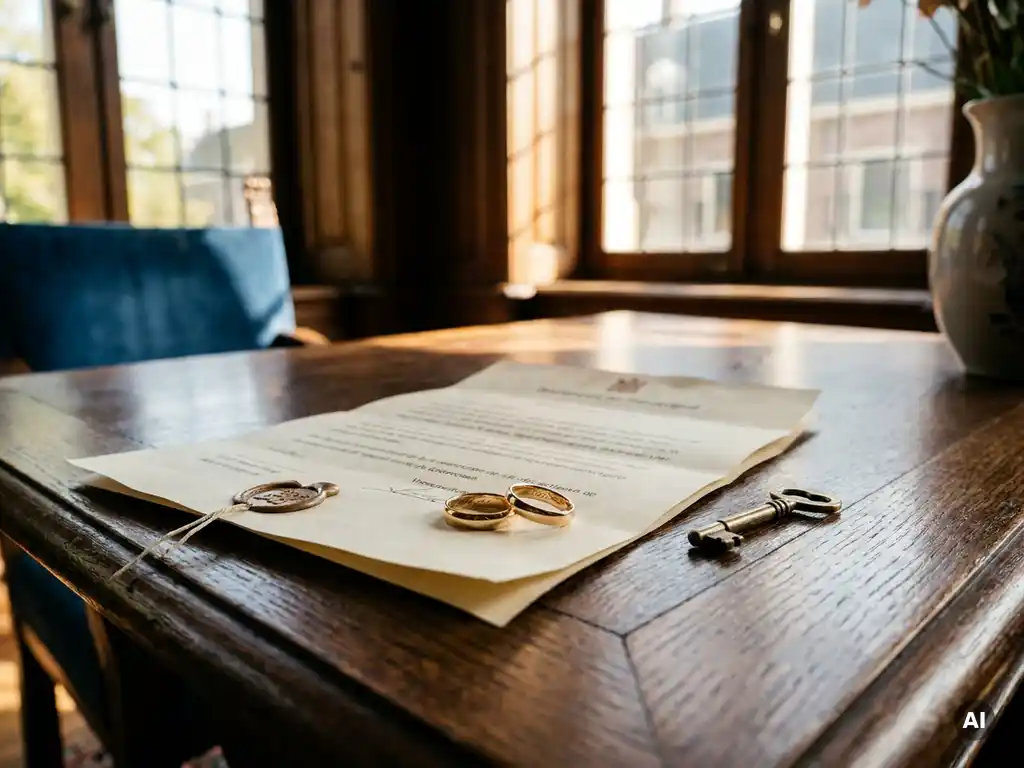
Community of property does not automatically apply to all married couples in the Netherlands. Since 2018, the default matrimonial property regime for couples who marry in the Netherlands without a prenuptial agreement is limited community of property (beperkte gemeenschap van goederen), which covers assets acquired during the marriage but generally excludes pre-marital assets and inheritances. For expats, the picture is more complex: the applicable regime depends on factors including nationality, habitual residence, and when and where the marriage took place. The sections below address the most common questions expats in the Netherlands have about matrimonial property law.
Does community of property automatically apply when you marry in the Netherlands?
When two people marry in the Netherlands without a prenuptial agreement, the limited community of property regime applies by default. This means that assets and debts accumulated during the marriage are shared equally between the spouses, while assets owned before the marriage, as well as inheritances and gifts received during the marriage, remain the separate property of the individual spouse who received them.
This represents a significant change from the rules that applied before 1 January 2018. Under the old regime, a full community of property (algehele gemeenschap van goederen) arose automatically upon marriage, meaning that virtually all assets and debts, including pre-marital ones, became jointly owned. Couples who married before 2018 under Dutch law and without a prenuptial agreement may therefore still be subject to the broader, full community of property regime, depending on the circumstances.
It is important to note that the default regime only applies automatically when no other arrangement has been made. Couples who draw up a prenuptial agreement (huwelijkse voorwaarden) before or during the marriage can choose a different regime entirely, such as full separation of assets or a tailored arrangement that suits their specific financial situation.
What assets are included and excluded under Dutch community of property?
Under the current Dutch limited community of property regime, the community includes all assets and debts that either spouse acquires during the marriage, regardless of which spouse’s name they are registered in. This covers income, savings accumulated during the marriage, jointly purchased property, and business interests built up after the wedding date.
The following categories are generally excluded from the community:
- Assets owned by either spouse before the marriage
- Inheritances received during the marriage, provided no community clause is attached
- Gifts received during the marriage, subject to the same condition
- Assets that replace excluded property (substitution), provided the link can be demonstrated
- Debts that existed before the marriage, which remain the personal liability of the spouse who incurred them
In practice, tracing and evidencing which assets fall inside or outside the community can be challenging, particularly where pre-marital savings have been mixed with marital income over many years. Careful financial record-keeping is advisable from the outset of a marriage, especially for individuals with significant pre-existing assets or business interests.
How does community of property affect expats married abroad?
For expats in the Netherlands who married abroad, the applicable matrimonial property regime is not automatically Dutch law. Under EU Regulation 2016/1103 on matrimonial property regimes, which applies to couples who married on or after 29 January 2019, the law of the country of the spouses’ first common habitual residence after the marriage generally governs their property regime. If that country was not the Netherlands, Dutch community of property rules may not apply at all.
For couples who married before 29 January 2019, the applicable rules depend on earlier Dutch private international law principles, which also looked primarily at the spouses’ first common habitual residence after the marriage. In both cases, the result is that an expat couple who married abroad and then relocated to the Netherlands may remain subject to the matrimonial property law of another country, for example, the law of the United Kingdom, the United States, or another EU member state.
This has practical consequences. A couple subject to English law, for instance, has no statutory matrimonial property regime in the same sense as Dutch law provides. A couple subject to German law may find that a different form of community applies. The key point is that relocating to the Netherlands does not automatically change the governing law of a couple’s matrimonial property regime, and assumptions based on Dutch domestic rules may be incorrect.
Can expats opt out of Dutch community of property rules?
Yes, expats can opt out of the applicable default matrimonial property regime, either by entering into a prenuptial agreement before the marriage or by amending their matrimonial property regime during the marriage. Under EU Regulation 2016/1103, couples also have a limited right to choose the applicable law, selecting the law of the nationality of either spouse or the law of their habitual residence at the time of making the choice.
- Prenuptial agreement before marriage: Couples who have not yet married can arrange a prenuptial agreement in the Netherlands before a civil-law notary (notaris). This agreement can establish full separation of assets, a tailored sharing arrangement, or any other structure that suits the couple’s circumstances.
- Postnuptial agreement during marriage: Couples who are already married can also amend their matrimonial property regime through a postnuptial agreement, again executed before a notary. This can be relevant for expats who married abroad under a regime that no longer suits their situation after relocating to the Netherlands.
- Choice of applicable law: Under the EU regulation, couples may formally elect the law of a specific country to govern their matrimonial property. This election must be made in writing and signed by both spouses.
Any change to a matrimonial property regime should be approached carefully, as it can have significant consequences for both spouses, including in relation to creditors. Independent legal advice for each spouse is strongly advisable before signing any such agreement.
What happens to community of property when an expat couple divorces in the Netherlands?
When an expat couple divorces in the Netherlands, the matrimonial property regime that governed their marriage must be dissolved and the assets divided accordingly. If Dutch limited community of property applies, the community assets and debts are in principle divided equally between the spouses. Assets that fall outside the community, such as pre-marital property or inherited assets, are returned to the spouse who owns them.
The division of matrimonial property on divorce is separate from other financial consequences of divorce, such as spousal maintenance (partneralimentatie) and, where children are involved, child support. Each of these matters is governed by its own rules and may involve different applicable laws depending on the international dimension of the case.
For expat couples, the international element can add considerable complexity. Questions that frequently arise include:
- Which country’s courts have jurisdiction over the divorce and the property division?
- Which country’s law governs the matrimonial property regime?
- How are assets located in different countries treated?
- Are there pension rights to be divided, and under which rules?
Where the couple’s matrimonial property is governed by the law of another country, Dutch courts will in principle apply that foreign law to the property division, which may require expert evidence on the content of that law. Outcomes can differ substantially depending on the applicable regime, making early legal advice essential when an international marriage breaks down.
When should expats seek legal advice on matrimonial property in the Netherlands?
Expats living in the Netherlands should consider seeking legal advice on matrimonial property at several key moments: before getting married, when relocating to the Netherlands as a married couple, when significant assets are acquired or a business is started, and certainly before or during divorce proceedings. Waiting until a dispute arises often makes resolution more complicated and costly.
Specific situations that warrant professional guidance include:
- Planning to marry in the Netherlands and wishing to understand the default regime before deciding whether a prenuptial agreement is appropriate
- Arriving in the Netherlands as a married couple and being uncertain which country’s matrimonial property law applies
- Purchasing property in the Netherlands and needing clarity on how ownership is structured between spouses
- Starting or acquiring a business in the Netherlands and wishing to protect business assets from the matrimonial community
- Facing separation or divorce and needing to understand rights and obligations under the applicable regime
Given the intersection of Dutch law, EU regulations, and potentially the law of one or more other countries, matrimonial property questions for expats rarely have straightforward answers. The applicable regime, the location of assets, and the couple’s personal circumstances all influence the outcome, and the specific situation of each individual always needs to be assessed carefully.
How Russell Advocaten assists expats with matrimonial property questions
Russell Advocaten is an internationally oriented law firm based in Amsterdam, with long-standing experience advising expats on a wide range of legal matters, including family law, real estate, contracts, immigration, and setting up a business in the Netherlands. The firm’s lawyers communicate fluently in English, German, and Dutch, which is a practical advantage for international clients navigating Dutch legal proceedings or documentation.
For expats with questions about matrimonial property, Russell Advocaten can assist with:
- Advising on which matrimonial property regime applies to your specific situation
- Drafting or reviewing prenuptial or postnuptial agreements before a Dutch notary
- Advising on the choice of applicable law under EU Regulation 2016/1103
- Guiding you through the property division process in the event of separation or divorce
- Coordinating cross-border legal questions through the international legal services for expats that the firm provides via its Primerus network of 3,000 lawyers in 40 countries
Russell Advocaten is an official partner of IN Amsterdam, the expat centre of the City of Amsterdam, and has been recommended by the Legal 500 for many years. If you have questions about your matrimonial property situation in the Netherlands, the firm’s lawyers are available to provide personal advice tailored to your circumstances. Contact Russell Advocaten to arrange a consultation.
This information is general in nature and does not constitute legal advice for your specific situation; for personal advice, please consult a lawyer at Russell Advocaten.
Veelgestelde vragen
If I married before 2018 in the Netherlands without a prenuptial agreement, am I still subject to the old full community of property regime?
Yes, in most cases. Couples who married in the Netherlands before 1 January 2018 without a prenuptial agreement are generally still governed by the old full community of property regime, meaning virtually all assets and debts — including pre-marital ones — are jointly owned. If this no longer suits your situation, it is possible to amend your matrimonial property regime through a postnuptial agreement executed before a Dutch notary, but this should be done with careful legal advice given the potential consequences for both spouses and any creditors.
How do I find out which country's matrimonial property law actually applies to my marriage?
The starting point is identifying where you and your spouse had your first common habitual residence after the marriage. Under EU Regulation 2016/1103 (for marriages on or after 29 January 2019), this is the primary connecting factor. For earlier marriages, Dutch private international law applied a similar approach. Because the analysis can involve multiple countries, nationalities, and the timing of your marriage, it is strongly advisable to consult a lawyer with international family law experience rather than assuming Dutch law automatically applies.
We bought a house in the Netherlands together — does it matter whose name is on the title deed for community of property purposes?
Under Dutch limited community of property, assets acquired during the marriage fall into the community regardless of which spouse’s name appears on the title deed. However, if the property was purchased using pre-marital funds or an inheritance, those contributions may remain the separate property of the contributing spouse — provided the financial trail can be clearly documented. This is why keeping thorough records of the source of funds used in major purchases is particularly important, especially for expats who may have brought significant assets from abroad.
What is the biggest mistake expats make when it comes to matrimonial property in the Netherlands?
The most common mistake is assuming that Dutch law automatically applies simply because you live in the Netherlands — or conversely, assuming it does not apply because you married abroad. Many expat couples also delay seeking legal advice until a separation or major financial transaction forces the issue, by which point their options may be more limited. Proactively clarifying which regime governs your marriage when you first relocate to the Netherlands can prevent costly disputes and surprises later on.
Can my spouse's business debts affect assets that I consider to be mine personally?
This depends on the applicable matrimonial property regime. Under Dutch limited community of property, debts incurred during the marriage in principle form part of the community, which means creditors of one spouse may in certain circumstances have recourse to community assets. Pre-marital debts, however, remain the personal liability of the spouse who incurred them. If one spouse runs a business, structuring the matrimonial property regime carefully — for example, through a prenuptial or postnuptial agreement — can be an important way to protect the other spouse’s personal assets from business-related risks.
Does relocating from the Netherlands to another country change the matrimonial property law that applies to us?
Generally, no. Under EU Regulation 2016/1103, the applicable matrimonial property law is fixed at the time of the marriage based on the spouses’ first common habitual residence, and it does not automatically change when a couple moves to a new country. The only way to change the governing law after marriage is by making a formal written choice of law under the regulation, selecting the law of either spouse’s nationality or the law of a new habitual residence. Such a choice should always be made with legal advice, as it can have far-reaching financial and legal consequences.
How should we get started if we want to draw up a prenuptial agreement in the Netherlands?
A prenuptial agreement in the Netherlands must be executed as a notarial deed before a Dutch civil-law notary (notaris) prior to the marriage ceremony — it cannot be signed on the wedding day itself. The process typically begins with a consultation with a family law lawyer to discuss your circumstances and objectives, followed by engagement with a notary to draft the agreement. For expats, it is particularly useful to work with a lawyer who can advise on the interaction between Dutch law and any foreign law that may also be relevant to your situation, ensuring the agreement is both legally sound and practically effective.
Gerelateerde artikelen
- How does relocation to the Netherlands affect your home country taxes?
- What areas of Dutch law affect expats the most?
- What are common legal problems expats face with housing in the Netherlands?
- Does the 30% ruling affect your mortgage options in the Netherlands?
- Can a foreigner start a business in the Netherlands?
Deze inhoud is gegenereerd met behulp van AI en kan fouten bevatten.