

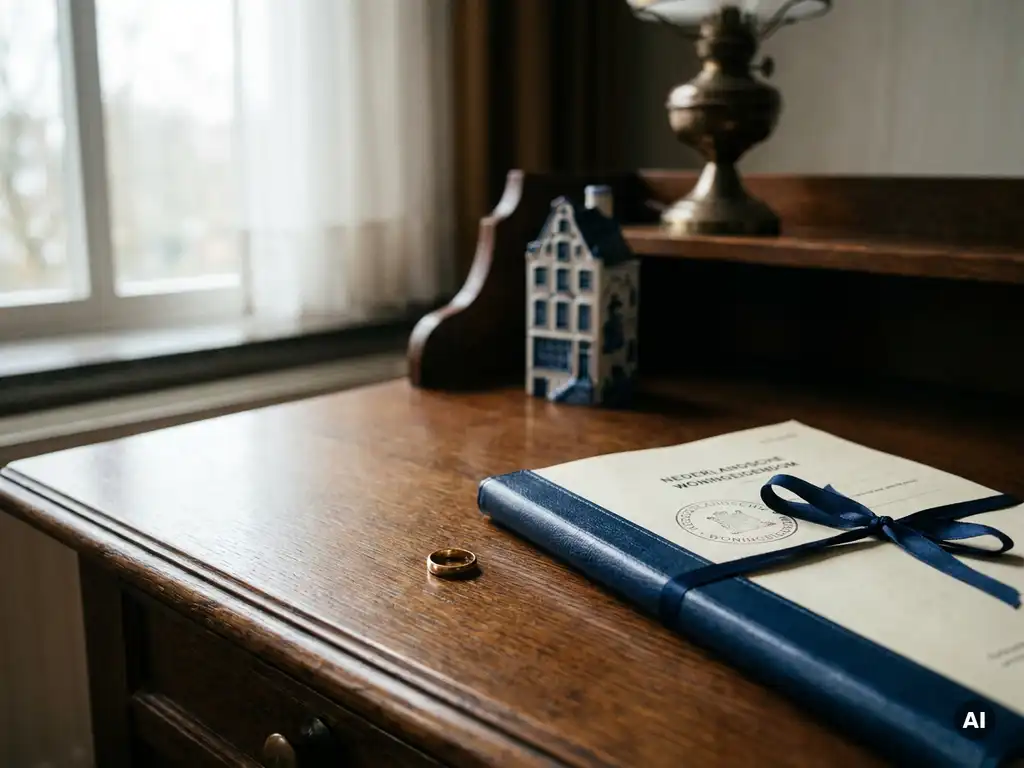
When an expat divorces in the Netherlands, the division of assets depends primarily on which country’s matrimonial property law governs the marriage, when the marriage took place, and whether a prenuptial agreement exists. Dutch law may apply by default in certain circumstances, but international private law rules often determine which legal system takes precedence. The sections below address the most common questions expats face when navigating a divorce in the Netherlands.
Which matrimonial property regime applies to expats divorcing in the Netherlands?
The matrimonial property regime that applies to an expat couple divorcing in the Netherlands is determined by international private law, not automatically by Dutch domestic law. For marriages concluded on or after 29 January 2019, the EU Matrimonial Property Regulation (EU 2016/1103) generally governs which country’s law applies. The starting point is the law of the country where the spouses first established their habitual residence after marriage.
If the couple settled in the Netherlands shortly after marrying, Dutch matrimonial property law is likely to apply. If they moved to the Netherlands later in the marriage, the law of their first shared habitual residence may continue to govern asset division, even if the divorce proceedings take place before a Dutch court. Spouses also have limited freedom to choose the applicable law, for example by selecting the law of either spouse’s nationality or the law of the country where one of them habitually resides.
For marriages concluded before 29 January 2019, older conflict-of-law rules apply, and the analysis can be more complex. The specific outcome depends on the individual circumstances of each marriage, which is why professional legal advice for expats is strongly recommended before drawing any conclusions.
How does the Dutch community of property regime divide assets?
Under the Dutch community of property regime (algehele gemeenschap van goederen), all assets and debts that both spouses own at the time of marriage, as well as those acquired during the marriage, are merged into a single shared estate. Upon divorce, this community is divided equally between the spouses, with each party receiving fifty per cent of the net value.
It is important to note that Dutch law was amended on 1 January 2018. Couples who married in the Netherlands from that date onwards are subject to a limited community of property (beperkte gemeenschap van goederen) by default. Under this regime, assets owned before the marriage and assets received as gifts or inheritances during the marriage are excluded from the community. Only assets and debts accumulated during the marriage are shared equally.
For expats, the practical implications depend on which country’s law governs the marriage. If Dutch law applies and the marriage predates 2018, the older full community regime may still be relevant. If the marriage falls under the post-2018 rules, premarital assets and inheritances are generally protected. In either case, the valuation of assets and the identification of what falls inside or outside the community can give rise to significant disputes, particularly where business interests, investment portfolios, or real property are involved.
What happens to assets held abroad when an expat divorces in the Netherlands?
Assets held abroad are not automatically excluded from a Dutch divorce settlement. If Dutch law governs the matrimonial property regime, the Dutch court will in principle take all assets into account, including real estate, bank accounts, pension entitlements, and business interests located outside the Netherlands. The applicable matrimonial property law determines whether those foreign assets fall within the shared estate.
However, enforcing a Dutch court order against assets located in another country is a separate matter. A Dutch judgment does not automatically have legal force abroad. Whether and how it can be enforced depends on:
- The country where the asset is located and its recognition rules for foreign judgments
- Whether an EU enforcement framework applies (within the European Union, recognition is generally more straightforward)
- The nature of the asset, for example whether it is immovable property, a bank account, or a shareholding
- Any bilateral treaties between the Netherlands and the relevant country
Expats with significant assets in multiple jurisdictions should be aware that parallel proceedings or recognition disputes can arise. Coordinating legal advice across relevant jurisdictions is often necessary to achieve a workable outcome.
Does a prenuptial agreement from another country hold up in the Netherlands?
A prenuptial agreement concluded in another country can be recognised in the Netherlands, but this is not guaranteed. Dutch courts will assess whether the agreement was validly concluded under the law that governed it at the time, and whether recognising it would be contrary to Dutch public policy (ordre public). If the agreement was properly executed and does not violate fundamental Dutch legal principles, it is generally respected.
Several factors influence whether a foreign prenuptial agreement will be upheld:
- Formal validity: The agreement must meet the formal requirements of the country in which it was made, such as notarisation or registration.
- Substantive validity: The content must not conflict with mandatory rules of the applicable law or with Dutch public policy.
- Applicable law: Under the EU Matrimonial Property Regulation, the law chosen in the agreement must be one of the permitted options, such as the law of a spouse’s nationality or habitual residence.
- Timing: Agreements concluded before the EU Regulation came into force may be assessed under older rules.
In practice, the enforceability of a foreign prenuptial agreement in a Dutch divorce is not always straightforward. Courts may scrutinise the circumstances in which it was signed, particularly if one party argues they did not fully understand its implications. Legal review of any existing agreement before or at the outset of divorce proceedings is advisable.
How are pension rights divided in a Dutch expat divorce?
Pension rights accrued during a marriage are subject to division upon divorce in the Netherlands under the Pension Rights upon Divorce Act (Wet verevening pensioenrechten bij scheiding). Under this Act, pension rights built up during the marriage are in principle divided equally between the spouses, regardless of who accrued them. Each former spouse is entitled to half of the pension rights accumulated during the period of the marriage.
For expats, the picture is more complicated because pension entitlements may have been accrued in multiple countries under different pension systems. Dutch law governs the division of pension rights accrued in the Netherlands, but foreign pension rights are subject to the rules of the country where they were built up. A Dutch court can take foreign pension rights into account when assessing the overall fairness of the settlement, but it cannot directly order a foreign pension fund to make payments.
Spouses may also agree to deviate from the standard equal division, for example by opting for conversion (conversie), whereby each spouse receives an independent pension entitlement rather than a share of the other’s pension. Any such arrangement must be formally recorded. Given the long-term financial significance of pension division, this is an area where specialist advice is particularly important.
Which court has jurisdiction over an expat divorce in the Netherlands?
Dutch courts have jurisdiction over an expat divorce if at least one of the spouses is habitually resident in the Netherlands or holds Dutch nationality. The EU Brussels IIb Regulation (which replaced Brussels IIa from 1 August 2022) sets out the jurisdictional rules for divorce proceedings within the European Union. Under this framework, a Dutch court may accept jurisdiction on several grounds, including where both spouses are habitually resident in the Netherlands, or where one spouse has been habitually resident there for at least six months immediately before the application.
Where one spouse is not an EU resident or where the other spouse is located outside the EU, Dutch courts may still accept jurisdiction based on Dutch national rules. The court that has jurisdiction over the divorce does not necessarily have jurisdiction over all related matters, such as the division of assets or parental responsibility, which may be governed by separate regulations.
For expats, the question of jurisdiction is strategically significant. Different countries may reach different outcomes on asset division, maintenance, and pension rights. In some cases, both spouses may have the option to initiate proceedings in more than one country, and the country in which proceedings are started first may determine which court takes jurisdiction. This makes early legal advice essential for anyone contemplating or facing divorce proceedings with an international dimension.
How Russell Advocaten can assist expats with divorce in the Netherlands
Russell Advocaten is an internationally oriented law firm based in Amsterdam, with extensive experience advising expats on a wide range of legal matters, including family law, immigration, real estate, contracts, and employment. The firm’s lawyers communicate fluently in English, German, and Dutch, which means expats can discuss complex personal and financial matters in the language they are most comfortable with.
For expats facing divorce in the Netherlands, Russell Advocaten offers practical, informed support across the issues that matter most:
- Determining which country’s matrimonial property law applies to the marriage
- Assessing the validity and enforceability of foreign prenuptial agreements
- Advising on the division of assets held in multiple jurisdictions
- Guiding clients through Dutch pension division rules and their interaction with foreign pension entitlements
- Advising on jurisdictional strategy when proceedings could be initiated in more than one country
- Coordinating with legal counsel in other countries through the international Primerus network, which spans more than 3,000 lawyers in 40 countries
Russell Advocaten is an official partner of IN Amsterdam, the expat centre of the City of Amsterdam, and has been recommended by The Legal 500 for many years. If you are an expat dealing with a divorce or separation in the Netherlands and would like to understand your legal position, contact Russell Advocaten to arrange a consultation.
This information is general in nature and does not constitute legal advice for your specific situation; for advice tailored to your circumstances, please consult a lawyer at Russell Advocaten.
Veelgestelde vragen
Can I reach a divorce settlement by mutual agreement with my spouse, or does everything have to go through a Dutch court?
Yes, expat couples divorcing in the Netherlands can reach a settlement by mutual agreement, which is often faster and less costly than contested court proceedings. In practice, spouses negotiate the division of assets, pension rights, maintenance, and any parental arrangements, then formalise the outcome in a divorce settlement agreement (echtscheidingsconvenant). A Dutch court still needs to formally grant the divorce, but if both parties agree on all terms, the process is significantly more straightforward. A lawyer or mediator can help draft an agreement that is legally sound and enforceable.
What are the most common mistakes expats make when divorcing in the Netherlands?
One of the most frequent mistakes is assuming that Dutch law automatically applies simply because the divorce takes place in the Netherlands — in reality, the governing matrimonial property law depends on international private law rules and the couple’s history. Another common error is failing to act quickly on jurisdiction: if proceedings could be started in more than one country, the country where the first application is filed often determines which court takes over, which can have a significant impact on the financial outcome. Expats also frequently underestimate the complexity of dividing foreign assets and pensions, and delay seeking specialist advice until disputes have already escalated.
How long does an expat divorce typically take in the Netherlands?
The timeline varies considerably depending on whether the divorce is contested or uncontested and how complex the financial arrangements are. An uncontested divorce where both parties agree on all terms can be finalised within a few months. Contested proceedings, particularly those involving cross-border asset disputes, foreign pension entitlements, or jurisdictional challenges, can take one to several years. Gathering documentation for assets held abroad — such as property valuations, pension statements, and business accounts — can itself add significant time to the process.
If my spouse and I are both non-Dutch nationals living in the Netherlands, can we choose which country's law governs our asset division?
Yes, under the EU Matrimonial Property Regulation (EU 2016/1103), spouses have a limited but meaningful ability to choose the applicable law. The permitted options include the law of either spouse’s nationality or the law of the country where either spouse habitually resides at the time the choice is made. This choice must be made in writing and signed by both parties, typically as part of a prenuptial or postnuptial agreement. Choosing the applicable law can provide greater certainty and predictability, but the choice must be made carefully — the financial consequences under different legal systems can differ substantially.
What happens to the family home in the Netherlands if only one spouse is on the title?
Even if only one spouse is named on the title deed, the family home may still form part of the shared marital estate depending on which matrimonial property regime applies. Under Dutch community of property rules, property acquired during the marriage is generally shared regardless of whose name it is registered in. If the home was purchased before the marriage or funded entirely by one spouse’s pre-marital assets or inheritance, it may be excluded under the post-2018 limited community regime — but this needs to be carefully documented. The spouse not on the title may also have occupancy rights during divorce proceedings, which a Dutch court can regulate on a provisional basis.
Do I need a Dutch lawyer specifically, or can my lawyer from my home country handle my divorce in the Netherlands?
For divorce proceedings before a Dutch court, you will need a lawyer who is admitted to practise in the Netherlands, as Dutch procedural rules require legal representation by a locally qualified advocate (advocaat) in family law matters. However, your home-country lawyer can play a valuable supporting role, particularly in advising on the law of your nationality, reviewing foreign prenuptial agreements, or coordinating the enforcement of a Dutch judgment abroad. The most effective approach for internationally complex divorces is often a collaboration between Dutch counsel and a lawyer in the other relevant jurisdiction.
Can maintenance (alimony) obligations be affected by which country's law governs our divorce?
Yes, spousal maintenance is determined separately from matrimonial property division and is governed by its own set of international rules — in the EU context, primarily the EU Maintenance Regulation and the 2007 Hague Protocol on the law applicable to maintenance obligations. Dutch courts applying Dutch law can award spousal maintenance for up to twelve years following divorce, though recent reforms have introduced limits in certain circumstances. The amount and duration of maintenance can differ significantly depending on which country’s law applies, making jurisdictional strategy an important consideration when maintenance is likely to be a significant issue in the divorce.
Gerelateerde artikelen
- What is a diplomat clause in a Dutch rental agreement?
- Does Dutch law apply to expats who marry in the Netherlands?
- Can expats transfer their pension when leaving the Netherlands?
- Can a US citizen move to the Netherlands?
- Do I have to pay US taxes if I live in the Netherlands?
Deze inhoud is gegenereerd met behulp van AI en kan fouten bevatten.