

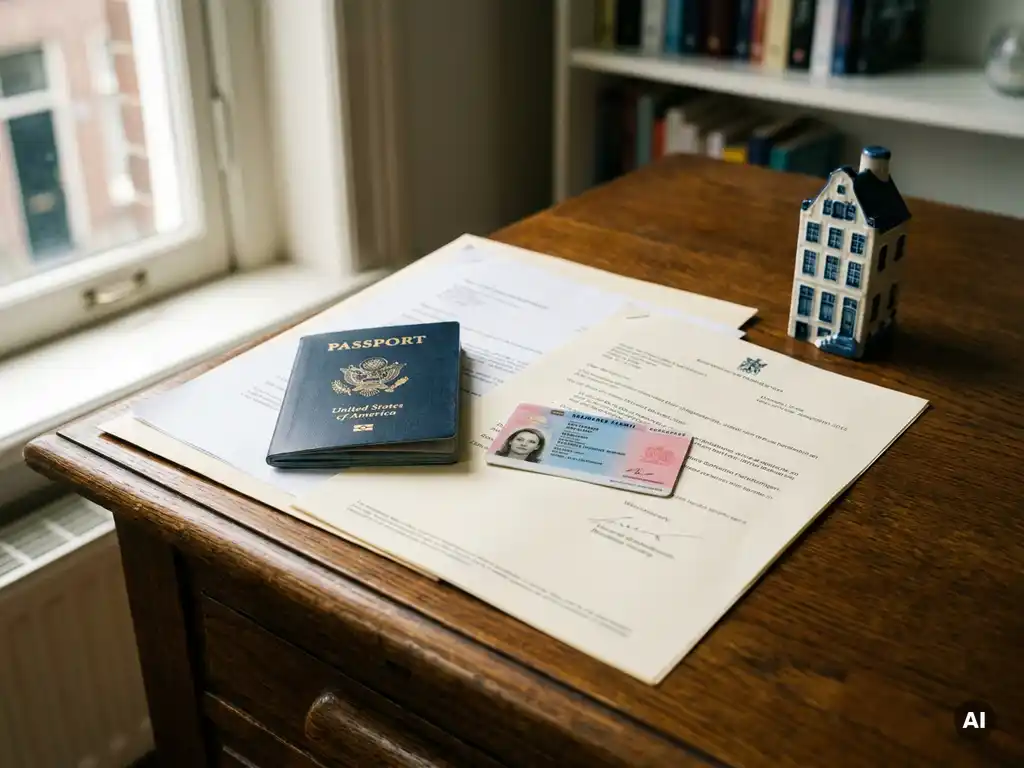
To move to the Netherlands legally, you will need a valid passport, a residence permit or visa appropriate to your purpose of stay, and, in most cases, proof of sufficient income. The exact combination of documents depends on your nationality, the reason for your move, and how long you intend to stay. The sections below address the most common questions international residents and businesses face when relocating to the Netherlands.
Which visa or permit do you need before entering the Netherlands?
The permit or visa you need before entering the Netherlands depends on your nationality and the purpose of your stay. Non-EU nationals who intend to stay for longer than 90 days generally require a Machtiging tot Voorlopig Verblijf (MVV), a provisional residence permit, collected from a Dutch embassy or consulate before departure. This entry visa runs concurrently with an application for a residence permit through the Dutch Immigration and Naturalisation Service (IND).
The most common permit categories for international relocation to the Netherlands include:
- Highly skilled migrant permit — for professionals with scarce skills, a higher educational level, and a contract with an IND-recognised employer sponsor
- EU Blue Card — for highly qualified third-country nationals with a relevant degree and a work contract meeting the minimum income threshold (€5,937 gross per month in 2026)
- Self-employment permit — for freelancers and independent professionals who can demonstrate a substantial benefit to the Dutch economy
- Start-up visa — for foreign entrepreneurs developing an innovative product or service, in cooperation with a recognised facilitator
- Student residence permit — for those enrolled in an accredited full-time programme at a recognised Dutch university or HBO institution
- Partner or family reunification permit — for those joining a partner or family member already legally residing in the Netherlands
- Orientation year permit (zoekjaar) — for recent graduates seeking employment in the Netherlands for up to one year
Nationals of EU and EEA member states, as well as citizens of the United States, Canada, Australia, New Zealand, South Korea, Switzerland, and the Vatican, are exempt from the MVV requirement. However, exemption from the MVV does not necessarily mean no documents are required; registration and income conditions may still apply depending on the length and purpose of stay.
What documents are required for a Dutch residence permit application?
Regardless of the type of residence permit you are applying for, all applicants must submit a core set of documents. A valid passport or recognised travel document is the primary requirement. Beyond that, the IND requires evidence that you do not pose a risk to public order or national security, and applicants over the age of 12 must complete an Appendix Antecedents Certificate disclosing any prior offences.
The standard documents required for a Dutch residence permit application typically include:
- A valid passport or travel document
- A completed Appendix Antecedents Certificate (for applicants aged 12 and over)
- Proof of sufficient, independent, and sustainable income, either your own or your sponsor’s
- A tuberculosis (TB) test result, completed after arrival in the Netherlands (required for most applicants from certain countries)
- Permit-specific documentation, such as an employment contract, business plan, proof of enrolment, or marriage certificate
In addition to these core documents, each permit type carries its own requirements. A highly skilled migrant, for example, must hold a contract with an IND-recognised sponsor organisation and meet the applicable minimum gross salary threshold. A self-employed applicant must submit a business plan demonstrating economic added value, assessed either by a relevant Dutch ministry or the Netherlands Enterprise Agency (RVO). A partner permit requires proof of a long-term exclusive relationship, cohabitation, and the sponsor’s compliance with income requirements.
It is worth noting that income requirements vary depending on the source of income, employment, self-employment, or other, and the specific permit category. Applicants are advised to verify the current thresholds with the IND or seek legal guidance before submitting an application, as requirements can change.
Do EU citizens need documents to live and work in the Netherlands?
EU citizens do not need a residence permit or a work permit to live and work in the Netherlands. Freedom of movement under EU law grants them the right to reside and take up employment without prior authorisation from the IND. However, this does not mean that no formalities apply.
EU citizens who intend to stay in the Netherlands for more than four months are required to register at their local municipality (gemeente) and be entered in the Personal Records Database (BRP). To do so, a valid passport or national identity card is required. For an indefinite right of residence, additional conditions apply: the individual must be financially independent, registered in the BRP, and have resided in the Netherlands for at least five years.
Family members of EU citizens who are themselves non-EU nationals may also be entitled to reside in the Netherlands, provided the EU citizen meets the conditions of financial independence, BRP registration, and five years of continuous residence. For those who are retired, incapacitated for work, or frontier workers, more lenient conditions may apply.
Turkish nationals benefit from more favourable immigration conditions under the Association Agreement between Turkey and the EU, including reduced legal fees and certain preferential admission rules. The specific scope of these benefits depends on individual circumstances and should be assessed on a case-by-case basis.
What is the 30% ruling and what documents does it require?
The 30% ruling is a Dutch tax facility that allows qualifying international employees to receive up to 30% of their gross salary tax-free, in recognition of the extra costs associated with relocating to the Netherlands from abroad. It is designed for expats in the Netherlands who have been recruited from outside the country and possess skills that are scarce on the Dutch labour market.
To qualify, an employee must generally meet the following conditions:
- Be recruited or transferred from abroad to work in the Netherlands
- Have lived more than 150 kilometres from the Dutch border for at least 16 of the 24 months prior to starting work in the Netherlands
- Meet the applicable minimum salary threshold set by the Dutch Tax and Customs Administration (Belastingdienst)
- Hold a valid employment contract with a Dutch employer registered with the Belastingdienst
The documents typically required to apply for the 30% ruling include a copy of the employment contract, proof of the employee’s previous residential address abroad, and evidence of the employee’s qualifications or expertise. The application is submitted jointly by the employer and employee to the Belastingdienst.
It is important to note that the 30% ruling has undergone legislative changes in recent years, and the applicable percentage and conditions may differ depending on when the ruling was first granted. Given the fiscal implications, individuals considering international relocation to the Netherlands are strongly advised to seek tailored professional advice rather than relying solely on general information.
How does the municipality registration (BRP) work and what do you need?
All internationals who stay in the Netherlands for more than three months must register at their local municipality (gemeente) to be entered in the Basisregistratie Personen (BRP), the Personal Records Database. This registration is a legal obligation and is a prerequisite for many practical steps in daily life, including opening a Dutch bank account, accessing healthcare, and receiving a citizen service number (Burgerservicenummer, or BSN).
To register at the municipality, you will typically need to bring:
- A valid passport or travel document
- Proof of your address in the Netherlands (such as a rental agreement or a declaration from your landlord)
- Your residence permit or MVV, if applicable
- A birth certificate (in some municipalities, particularly for family registrations)
Registration must take place at the municipality where you live. If you are renting a house in the Netherlands as an expat, your rental agreement serves as the primary proof of address. It is worth noting that if the IND later determines that you have moved your main residence outside the Netherlands, for instance, by spending extended periods abroad or deregistering from the BRP, your right of residence may be withdrawn or not renewed.
EU citizens staying for more than four months are subject to the same BRP registration requirement, even though they do not require a residence permit. Registration is a practical and legal cornerstone of settling in the Netherlands, and it should be completed promptly after arrival.
How Russell Advocaten supports international companies and expats relocating to the Netherlands
Navigating Dutch immigration requirements, tax facilities, and registration obligations can be complex, particularly for those unfamiliar with the Dutch legal landscape. Russell Advocaten Amsterdam is an internationally oriented law firm with decades of experience advising expats in the Netherlands and foreign companies entering the Dutch market. The firm’s lawyers communicate fluently in English, German, and Dutch, making them well placed to guide international clients through every stage of relocation.
Russell Advocaten’s support for expats and international businesses covers a broad range of legal matters, including:
- Advice on residence and work permit requirements, tailored to your nationality and purpose of stay
- Guidance on setting up a business in the Netherlands as a foreigner, including corporate structures, registration, and compliance
- Legal support with employment contracts, personnel matters, and reorganisations
- Assistance with real estate transactions, including buying a house in the Netherlands as a foreigner and navigating rental agreements, including the diplomat clause
- Family law matters relevant to international relocation, such as partner permits and family reunification
- Cross-border legal support through the international Primerus network, covering 3,000 lawyers in 40 countries
Russell Advocaten is an official partner of IN Amsterdam, the expat centre of the Municipality of Amsterdam, and has been recommended by the Legal 500 for many years. The firm regularly organises workshops on Dutch law for the international community.
This information is general in nature and does not constitute legal advice for your specific situation. For tailored guidance on your relocation to the Netherlands, contact Russell Advocaten to speak with one of our lawyers directly.
Veelgestelde vragen
How long does it typically take to get a Dutch residence permit approved?
Processing times vary depending on the permit type and individual circumstances. For highly skilled migrant permits, the IND aims to decide within two weeks when the employer is a recognised sponsor. More complex applications, such as self-employment or family reunification permits, can take up to three months or longer. It is advisable to begin your application well in advance of your intended start date and to ensure all documents are complete to avoid unnecessary delays.
What happens if my residence permit application is rejected?
If the IND rejects your application, you will receive a written decision explaining the grounds for refusal. You have the right to submit a notice of objection (bezwaar) within four weeks of the decision, and if that is also rejected, you can appeal to an administrative court. Given the legal complexity and the impact a rejection can have on your plans, it is strongly recommended to seek legal advice before submitting an objection or appeal, as procedural errors can undermine an otherwise valid case.
Can I bring my non-EU spouse or partner to the Netherlands on a family reunification permit?
Yes, provided you meet the conditions as the sponsoring partner. You must hold a valid residence permit yourself (or be an EU citizen meeting the financial independence and BRP registration requirements), earn at least the applicable minimum income threshold, and be able to demonstrate a genuine and exclusive relationship. Your partner will need to apply for a provisional residence permit (MVV) at a Dutch embassy or consulate in their home country before travelling to the Netherlands, and both parties will need to submit supporting documentation such as proof of cohabitation, communication, and financial dependency where relevant.
Do I need a Dutch bank account before I can register at the municipality, or is it the other way around?
Municipality registration (BRP) generally comes first. Once registered, you receive a Burgerservicenummer (BSN), which most Dutch banks require before they will open an account in your name. This means arriving with sufficient funds accessible through your existing foreign bank account or an international banking solution is important during the initial weeks. Some international banks and fintech providers, such as Wise or Bunq, offer accounts that can be opened without a BSN, which can serve as a practical bridge while you complete your registration.
What is the minimum income requirement for a highly skilled migrant permit in 2026?
For 2026, the minimum gross monthly salary threshold for highly skilled migrants under the age of 30 is approximately €3,909, while those aged 30 and over must earn at least €5,331 gross per month. Reduced thresholds apply for orientation year (zoekjaar) permit holders transitioning into employment. These figures are updated annually by the IND, so it is important to verify the current thresholds directly with the IND or through a qualified immigration lawyer before submitting your application.
Is it possible to switch from one type of residence permit to another while already living in the Netherlands?
In most cases, yes — it is possible to change the purpose of your residence permit without leaving the Netherlands, a process known as changing the restriction (wijziging van het verblijfsdoel). For example, a student who graduates and finds employment may be able to transition to a highly skilled migrant permit, or an orientation year permit holder may convert to a work permit upon securing a qualifying job. However, not all transitions are straightforward, and some changes may require you to meet new conditions or even apply from abroad. Seeking legal advice before initiating a change of purpose is strongly recommended to avoid gaps in your legal residence status.
What common mistakes should I avoid when preparing my Dutch residence permit application?
The most frequent pitfalls include submitting documents that are not officially translated into Dutch, English, French, or German; providing financial evidence that does not meet the IND’s specific format or recency requirements; and underestimating the time needed to collect apostilled or legalised documents from abroad. Another common mistake is failing to account for the TB test requirement, which must be completed after arrival and can add several weeks to the process. Starting your preparation early, creating a checklist based on your specific permit type, and having your application reviewed by an immigration professional before submission can significantly reduce the risk of delays or rejection.
Gerelateerde artikelen
- What is the startup visa in the Netherlands and who qualifies?
- How long can you benefit from the 30% ruling in the Netherlands?
- What is IN Amsterdam and how can it help expats?
- What does expat mean?
- How much does an immigration lawyer cost in the Netherlands?
Deze inhoud is gegenereerd met behulp van AI en kan fouten bevatten.