

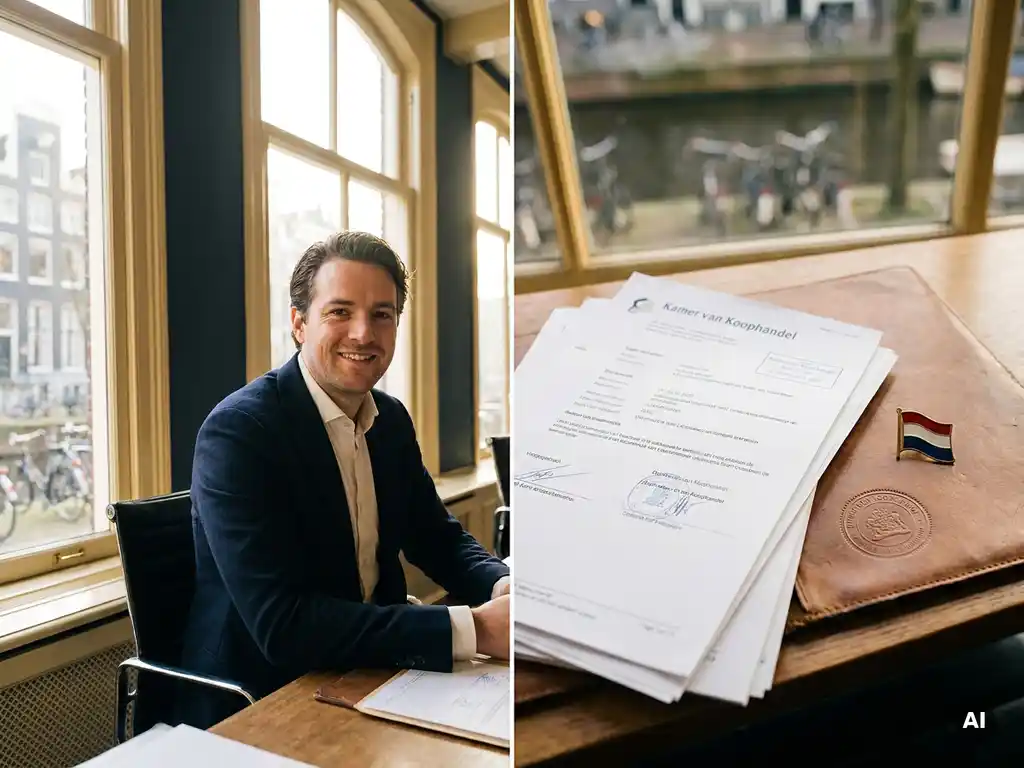
Yes, a non-EU citizen can start a startup in the Netherlands, provided they obtain the correct residence and business permits before commencing operations. The Netherlands has a dedicated startup permit designed specifically for non-EU entrepreneurs who wish to build an innovative business in the country. The sections below address the most common questions founders ask when exploring this route.
What permits does a non-EU citizen need to start a business in the Netherlands?
A non-EU citizen who wants to set up a business in the Netherlands generally requires a residence permit for self-employment or, for early-stage ventures, a startup permit (start-up permit). Unlike EU citizens, who enjoy freedom of movement and do not need a work or residence permit to operate in the Netherlands, non-EU nationals must secure legal authorisation before they can live and work here in any capacity, including as a founder.
The type of permit required depends on the stage of the business and the founder’s circumstances. The two most relevant routes for non-EU entrepreneurs are:
- Startup permit: For founders in the early phase of building an innovative company, valid for one year and linked to a recognised facilitator.
- Self-employment residence permit: For founders with an established business plan and demonstrable added value to the Dutch economy, assessed against a points-based system.
In addition, depending on the founder’s country of origin, a provisional residence permit (machtiging tot voorlopig verblijf, or MVV) may be required as an entry visa before arriving in the Netherlands. Not every nationality requires an MVV, so it is important to verify this with the Immigration and Naturalisation Service (IND) at an early stage. General residence permit requirements, such as holding a valid passport, meeting income requirements, and passing a tuberculosis test on arrival, apply across all permit categories.
What is the Dutch startup permit and who qualifies for it?
The Dutch startup permit is a one-year residence permit that allows a non-EU national to develop an innovative business in the Netherlands under the guidance of a recognised facilitator. It is intended for founders who are still in the early stages of building their company and need time to validate their concept, develop a product, and establish a market presence before applying for a longer-term permit.
To qualify for the startup permit, an applicant must generally meet the following conditions:
- The business concept is innovative: it introduces a new product, service, or process to the Dutch or international market.
- The founder works with a recognised facilitator who provides guidance and supervision throughout the permit year.
- The founder has sufficient financial means to support themselves during the permit period.
- The founder is registered with the Dutch Chamber of Commerce (Kamer van Koophandel, KvK).
It is worth noting that the startup permit does not automatically lead to a permanent right to reside or operate in the Netherlands. After the one-year period, the founder must either transition to a self-employment residence permit or another applicable permit category. Whether a particular business concept qualifies as sufficiently innovative is assessed on a case-by-case basis, and outcomes can vary depending on the specific circumstances of the application.
What is a recognised facilitator and why is one required?
A recognised facilitator is an organisation or individual officially approved by the IND to guide and supervise non-EU startup founders during the permit year. The facilitator plays a central role in the startup permit application: without one, the permit cannot be granted. The IND requires a facilitator because it provides an accountability structure: the facilitator assesses the viability of the business concept and takes responsibility for supporting the founder’s development.
Recognised facilitators typically include:
- Business incubators and accelerators
- Entrepreneurship support organisations
- Investment funds and venture capital firms
- Universities and knowledge institutions with entrepreneurship programmes
The facilitator must be formally recognised by the IND before they can act in this capacity. Their role goes beyond a formality: they are expected to provide active mentoring, access to networks, and practical business support. The quality and track record of the facilitator can also influence how the IND assesses the overall application. Founders should therefore select a facilitator carefully, ensuring the organisation has genuine expertise relevant to their sector and business model. The IND publishes a list of recognised facilitators, which is the appropriate starting point for identifying a suitable partner.
Can a non-EU founder switch from a startup permit to a permanent business permit?
After the one-year startup permit expires, a non-EU founder can apply for a self-employment residence permit if their business has developed sufficiently. This permit is not automatically granted: the IND assesses the application against a points-based system that evaluates the founder’s personal experience, the business plan, and the added value the business brings to the Dutch economy.
The transition from a startup permit to a self-employment permit is a critical step, and the outcome depends on how well the founder has used the startup year to build a credible, operational business. Factors that the IND typically considers include the commercial progress made, the founder’s relevant experience and qualifications, and whether the business contributes meaningfully to Dutch society or the economy. A business that has generated revenue, secured clients, or attracted investment is generally better positioned than one that remains at the conceptual stage.
It is also possible, in some cases, for a founder who has developed a business to qualify for the highly skilled migrant permit (kennismigrant) if the company becomes a recognised IND sponsor and the founder draws a salary that meets the applicable income threshold. As of 1 January 2026, the general minimum gross monthly salary requirement for highly skilled migrants applies, and the specific figure should be verified with the IND or a legal adviser, as these thresholds are updated periodically. Each route has distinct requirements, and the most appropriate path will depend on the individual circumstances of the founder and the stage of the business.
What legal structure should a non-EU entrepreneur choose in the Netherlands?
The most common legal structures for non-EU entrepreneurs starting a business in the Netherlands are the private limited company (besloten vennootschap, BV) and the sole proprietorship (eenmanszaak). The choice of structure has significant implications for liability, taxation, and the founder’s ability to attract investment, and it should be considered carefully in light of the specific business model and growth ambitions.
The BV (private limited company)
The BV is the preferred structure for most startup founders, particularly those seeking external investment or planning to scale. It offers limited liability, meaning the founder’s personal assets are generally protected from business debts. The BV is a separate legal entity, which makes it easier to bring in co-founders, issue shares, and enter into commercial contracts. It also tends to be viewed more favourably by investors and institutional partners. Incorporation requires registration with the KvK and the drafting of articles of association.
The eenmanszaak (sole proprietorship)
The sole proprietorship is simpler and less costly to establish, but it does not provide limited liability: the founder is personally responsible for all business obligations. It is generally more suitable for freelancers or very early-stage operators with limited financial exposure. For a startup with growth ambitions or external funding, the BV is typically the more appropriate choice.
The choice of legal structure is not merely administrative: it affects director liability, shareholder rights, and the governance framework of the business. Non-EU founders should seek legal advice before incorporating, as the structure chosen at the outset can be difficult and costly to change later.
What legal risks should non-EU startup founders be aware of in the Netherlands?
Non-EU startup founders in the Netherlands face a distinct set of legal risks that go beyond those encountered by domestic entrepreneurs. Understanding these risks at an early stage can help founders structure their business and operations in a way that minimises exposure.
Key legal risk areas include:
- Permit compliance: Operating without the correct residence or work permit, or allowing a permit to lapse, can have serious consequences, including fines, deportation, or a ban on future applications. Founders must monitor permit validity and initiate renewal applications in good time.
- Director liability: Under Dutch law, directors of a BV can be held personally liable for certain acts or omissions, particularly in cases of mismanagement, failure to file accounts on time, or insolvency. Non-EU founders who are also directors should understand the scope of this liability from the outset.
- Employment law obligations: If the startup hires staff in the Netherlands, Dutch employment law applies in full, including rules on contracts, dismissal, and employee participation rights. These obligations can be more extensive than founders from other jurisdictions expect.
- Contractual risks: Commercial contracts governed by Dutch law, including lease agreements, supplier contracts, and shareholder agreements, require careful drafting. Standard international templates may not adequately reflect Dutch legal requirements.
- Intellectual property: Founders should ensure that IP developed within the company is properly assigned to the legal entity, not held personally. This is particularly important when multiple co-founders are involved.
The legal landscape for non-EU entrepreneurs in the Netherlands is navigable, but it is more complex than for EU nationals. The specific risks that apply will depend on the founder’s nationality, the structure of the business, and the sector in which it operates. It is advisable to obtain legal advice tailored to the specific situation rather than relying solely on general guidance.
How Russell Advocaten Supports Non-EU Startup Founders in the Netherlands
Russell Advocaten is an internationally oriented law firm based in Amsterdam, with long-standing experience in advising expats and foreign entrepreneurs on legal advice for expats across a wide range of matters, from setting up a business in the Netherlands to employment law, real estate, contracts, and immigration. The firm’s lawyers communicate fluently in English, German, and Dutch, which makes them a practical and accessible partner for non-EU founders navigating the Dutch legal system.
For non-EU entrepreneurs considering or already pursuing a startup in the Netherlands, Russell Advocaten can assist with:
- Advising on the appropriate permit route and the legal requirements that apply to your specific situation
- Structuring the business in the most appropriate legal form, including BV incorporation and shareholder arrangements
- Drafting and reviewing commercial contracts, lease agreements, and employment contracts under Dutch law
- Advising on director liability and corporate governance from the outset
- Supporting the transition from a startup permit to a self-employment or other long-term permit
Russell Advocaten is an official partner of IN Amsterdam, the expat centre of the City of Amsterdam, and has been recommended by The Legal 500 for many years. If you are a non-EU founder looking to establish or grow a business in the Netherlands, contact Russell Advocaten to discuss your situation with an experienced adviser.
This information is general in nature and does not constitute legal advice for your specific situation. Please consult a lawyer at Russell Advocaten for advice tailored to your circumstances.
Veelgestelde vragen
How long does it typically take to obtain a Dutch startup permit, and when should I start the application process?
The IND’s target processing time for a startup permit application is approximately two weeks once a complete application has been submitted, but in practice the overall timeline — including finding a recognised facilitator, preparing documentation, and arranging an MVV if required — can take several months. It is advisable to begin the process at least three to six months before you intend to start operating in the Netherlands. Starting early also gives you adequate time to identify the right facilitator, which is often the most time-consuming step.
Can I apply for a Dutch startup permit if my business is already partially operational in another country?
Yes, having an existing business or prototype in another country does not automatically disqualify you, and in some cases it can strengthen your application by demonstrating traction and viability. However, the startup permit is specifically designed for the early-stage development of a business in the Netherlands, so the IND will want to see that there is a genuine and substantive Dutch component to the venture. You should be prepared to explain clearly how the Dutch phase of your business differs from or builds upon what you have already developed elsewhere.
What happens if my startup permit application is rejected — can I appeal or reapply?
If the IND rejects your startup permit application, you have the right to lodge an objection (bezwaar) within four weeks of receiving the decision, and if that is also unsuccessful, you can appeal to an administrative court. Rejections often come down to insufficient evidence of innovation, a weak facilitator relationship, or incomplete documentation, so addressing these gaps specifically in any objection or reapplication is essential. Engaging an immigration lawyer to review the rejection decision before responding significantly improves your chances of a successful outcome.
Do I need to be physically present in the Netherlands for the entire duration of the startup permit year?
There is no strict rule requiring continuous physical presence, but as a residence permit holder you are expected to genuinely reside in the Netherlands, and extended absences can jeopardise both your current permit and any future applications. Practically speaking, your facilitator will also expect you to be actively engaged in building the business locally, attending meetings, and making use of the support they provide. If you anticipate spending significant time abroad for business reasons, it is worth discussing this with your facilitator and, if necessary, seeking legal advice on how to document your activities appropriately.
What are the most common mistakes non-EU founders make when transitioning from a startup permit to a self-employment residence permit?
The most frequent mistake is underestimating how much commercial progress the IND expects to see by the end of the startup year — arriving at the transition stage with a business that is still entirely conceptual, with no revenue, clients, or concrete partnerships, significantly weakens the application. Founders also commonly fail to keep thorough records of their activities, milestones, and financial progress during the permit year, which makes it difficult to build a compelling case for the self-employment permit. Starting to prepare the self-employment permit application well before the startup permit expires — ideally with legal assistance — gives you the best chance of a smooth transition.
Can my co-founder also move to the Netherlands under the same startup permit arrangement?
Each co-founder who is a non-EU citizen must apply for their own startup permit individually, as the permit is issued on a personal basis and tied to the applicant’s specific role and circumstances. Both co-founders will need to work with a recognised facilitator, though it is possible for multiple founders of the same venture to work with the same facilitator. It is important to ensure that each application clearly defines the individual’s distinct role and contribution to the business, as the IND assesses each application on its own merits.
Are there any sector-specific restrictions or industries where the Dutch startup permit is harder to obtain?
The startup permit does not formally exclude any particular sector, but the innovation requirement means that businesses in highly commoditised or traditional industries — where the concept is not genuinely new to the Dutch or international market — will face greater scrutiny. Sectors such as fintech, deep tech, life sciences, and sustainability tend to align well with the IND’s innovation criteria, while a straightforward retail or hospitality concept would need a very compelling angle to qualify. If you are uncertain whether your business concept meets the innovation threshold, discussing it with a recognised facilitator or an immigration lawyer before submitting an application can save considerable time and cost.
Gerelateerde artikelen
- What is the difference between a work permit and a residence permit in the Netherlands?
- Does the 30% ruling affect your mortgage options in the Netherlands?
- Is it hard to relocate to the Netherlands?
- Which jobs are in demand in the Netherlands for foreigners?
- Do I have to pay US taxes if I live in the Netherlands?
Deze inhoud is gegenereerd met behulp van AI en kan fouten bevatten.