

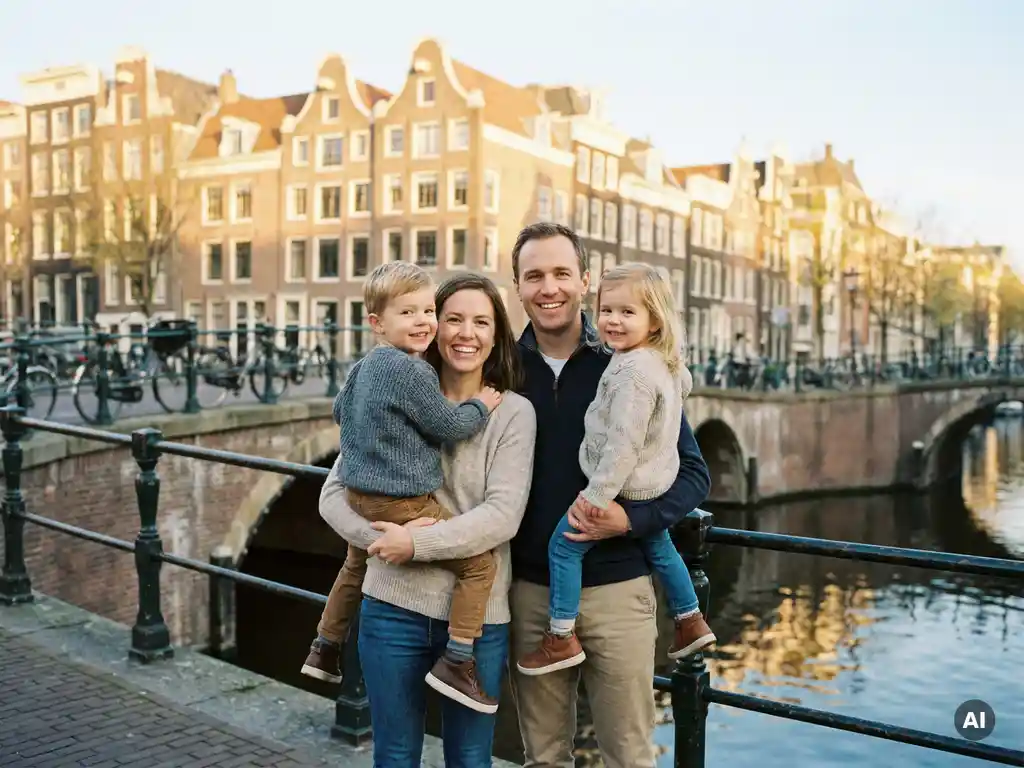
Yes, expats relocating to the Netherlands can generally bring their immediate family members with them. Dutch immigration law provides a family reunification route that allows a spouse or registered partner, and dependent children, to join an expat who holds a valid Dutch residence permit. The key condition is that the expat, as the main permit holder, meets the income and housing requirements set by the Immigration and Naturalisation Service (IND). The sections below address the most common questions expat families ask before and after making the move.
Who qualifies as a family member under Dutch immigration law?
Under Dutch immigration law, the family members who may join an expat in the Netherlands are a spouse or registered partner, and unmarried children under the age of 18. In most cases, the family member must be in a genuine, exclusive, and long-term relationship with the permit holder, and both parties must be at least 21 years old, or 18 if they were married before arriving in the Netherlands and hold an internationally recognised marriage certificate.
It is important to note that not every residence permit entitles the holder to bring family. If the expat has come to the Netherlands for seasonal labour, a traineeship, or to gain work experience, family reunification is not permitted under those permit categories. Highly skilled migrants, employees transferred within a company, and holders of other standard work-related permits are generally eligible to sponsor their family members, provided the other conditions are met.
Children from a previous relationship may also qualify, but the specific requirements, including custody arrangements and documentation, can be more complex. Each family situation is assessed individually by the IND, so the outcome will depend on the particular circumstances involved.
What residence permit does an expat’s family need to enter the Netherlands?
Family members joining an expat in the Netherlands must apply for a family reunification residence permit (verblijfsvergunning gezinshereniging). This permit is tied to the expat’s own residence permit and is issued for the same duration, up to a maximum of five years. The application is submitted to the IND, and in many cases the expat, as the recognised sponsor, can file the application on behalf of their family members.
If the family member is travelling from outside the European Union and requires a long-stay visa (MVV) before entering the Netherlands, they will need to follow the combined TEV procedure (Toegang en Verblijf). This means the MVV can be collected from the Dutch embassy or consulate in their country of residence, and once in the Netherlands, the residence document must be collected from an IND Desk within two weeks of arrival.
EU, EEA, and Swiss nationals do not require a residence permit in the same way, as they have the right of free movement. However, if they plan to stay in the Netherlands for more than three months, they are still required to register with their local municipality (gemeente) and be entered in the Personal Records Database (BRP).
Can an expat’s partner work in the Netherlands on a family permit?
In most cases, yes. A partner who holds a family reunification residence permit linked to an expat’s work permit is generally entitled to work in the Netherlands without needing a separate work permit. This is one of the practical advantages of the family reunification route: the partner gains access to the Dutch labour market as part of the permit conditions, rather than having to apply independently.
However, the right to work is not automatic in every situation. It depends on the type of residence permit the main permit holder has. Where the partner’s permit does carry an unrestricted right to work, this will be stated on the residence document itself. Partners should verify this before accepting employment, as working without the correct authorisation can have consequences for both the individual and the employer.
Partners who wish to work as a self-employed professional or start their own business face a separate set of requirements. A distinct residence permit for self-employment or entrepreneurship may be needed, depending on the nature and scale of the planned activity.
What are the income and housing requirements for family reunification?
The expat, as the sponsoring permit holder, must demonstrate an independent, sustainable, and sufficient income to support their family members in the Netherlands. The income threshold is set by the IND and is reviewed periodically; it is generally linked to the statutory minimum wage. The income must come from employment or a recognised source and must be ongoing; temporary or uncertain income may not satisfy the requirement.
In addition to the income requirement, the family must have adequate housing in the Netherlands. The IND requires that the accommodation is suitable for the number of people who will live there. This is assessed in terms of size and habitability, and the expat must be able to demonstrate that the housing is available and legally occupied, whether rented or owned.
For expats renting a house in the Netherlands, it is worth being aware that some landlords include a diplomat clause in rental agreements, which allows either party to terminate the lease under specific conditions. Understanding the terms of a rental contract before signing is important, particularly for expat families whose circumstances may change during their stay.
How long does the family reunification application process take?
The IND aims to decide on a family reunification application within 90 days of receiving a complete application. In practice, processing times can vary depending on the volume of applications and the complexity of the individual case. If the TEV procedure applies, meaning the family member also needs an MVV, the process begins before the family member travels to the Netherlands, and the timeline should be factored into relocation planning.
The following steps give a general overview of the process:
- The expat (as recognised sponsor) submits the family reunification application to the IND, together with all required supporting documents.
- The IND assesses whether the income, housing, and relationship requirements are met.
- If an MVV is required, the IND notifies the Dutch embassy or consulate in the family member’s country of residence.
- The family member collects the MVV and travels to the Netherlands.
- Within two weeks of arrival, the family member collects their residence document from an IND Desk.
- All family members staying longer than three months register at the local municipality and are entered in the BRP.
Delays can occur if documentation is incomplete or if additional checks are required. It is advisable to begin the application process as early as possible, well before the intended date of relocation.
What should expat families arrange before and after arriving in the Netherlands?
Relocating to the Netherlands as a family involves a number of practical and administrative steps beyond the residence permit itself. Preparing for these in advance reduces stress and ensures that the family is legally compliant from the moment they arrive.
Before arriving
- Confirm that the family reunification application has been approved and that all travel documents are in order.
- Arrange suitable housing that meets the IND’s requirements for size and habitability.
- If children will attend school, research international schools or international departments of Dutch schools, particularly relevant for expat families who may qualify for a tax-free school fee reimbursement under the Expat Scheme (30% ruling).
- Understand the terms of any rental agreement, including any special clauses that may affect the tenancy.
After arriving
- Register at the local municipality (gemeente) within five days of arrival to be entered in the BRP and receive a BSN (citizen service number).
- Collect the residence document from an IND Desk within two weeks of arrival, if applicable.
- Attend a tuberculosis test if required; this must be done within three months of permit approval.
- Check whether an integration exam (inburgeringsexamen) is required; if so, a letter from DUO will set out the requirements and timeframe.
- Open a Dutch bank account and arrange health insurance, which is mandatory in the Netherlands.
Families should also be aware that maintaining main residency in the Netherlands is a condition of most residence permits. Extended periods abroad, beyond what the permit allows, can lead to the IND withdrawing or declining to renew the permit.
How Russell Advocaten can assist expat families relocating to the Netherlands
Navigating Dutch immigration rules, housing contracts, and employment law simultaneously is demanding, particularly for families relocating internationally. Russell Advocaten Amsterdam is an internationally oriented law firm with long-standing experience advising expats on a wide range of legal matters, including immigration, setting up a business, personnel matters, real estate, contracts, and family law. The firm’s lawyers communicate fluently in English, German, and Dutch, which is a practical advantage for international clients unfamiliar with Dutch legal procedures.
Russell Advocaten is an official partner of IN Amsterdam, the expat centre of the City of Amsterdam, and has advised expat families and international businesses for decades. The firm can assist with:
- Reviewing and advising on rental agreements, including diplomat clauses and other expat-specific provisions.
- Legal guidance on employment contracts and the rights of family members in the Dutch labour market.
- Advice on setting up a business in the Netherlands, for partners who wish to work independently.
- Family law matters that may arise during or after relocation.
- General legal support for navigating Dutch law as an expat or international company.
The specific outcome of any immigration or legal matter depends on individual circumstances, and this article provides general information rather than legal advice for your specific situation. For tailored guidance, contact Russell Advocaten to discuss your family’s situation with one of the firm’s experienced lawyers.
This information is general in nature and does not constitute legal advice for your specific situation; for that, please consult a lawyer at Russell Advocaten.
Veelgestelde vragen
Can an expat bring their parents or adult siblings to the Netherlands under family reunification?
Dutch family reunification rules are generally limited to a spouse or registered partner and dependent children under 18 — parents, adult siblings, and other extended family members do not qualify under the standard family reunification route. In exceptional circumstances, such as where a family member is genuinely dependent on the permit holder, an alternative application may be possible, but these cases are assessed strictly and are rarely approved. If your situation involves extended family members, it is advisable to seek legal advice before submitting any application to the IND.
What happens to the family's residence permits if the expat loses their job or changes employer?
Because family reunification permits are tied to the main permit holder’s residence permit, any significant change in the expat’s employment situation — such as redundancy, a change of employer, or a gap in income — can directly affect the validity of the family’s permits. The IND may review whether the income and sponsorship conditions are still being met, and in some cases the family permits may be withdrawn or not renewed. It is important to notify the IND of relevant changes promptly and, where possible, to secure a new qualifying position before the existing permit lapses.
Does the 30% ruling (Expat Scheme) apply to a partner who starts working in the Netherlands on a family permit?
The 30% ruling is a tax benefit tied to the individual employee, not to the household, so a partner who finds employment in the Netherlands would need to meet the 30% ruling’s own eligibility criteria independently — including the salary threshold and the requirement to have been recruited from abroad. Simply being the spouse of a 30% ruling holder does not automatically extend the benefit to the partner’s income. Partners considering employment in the Netherlands should check their eligibility with a tax adviser or employment lawyer before assuming the ruling applies to them.
What if the family reunification application is refused by the IND — is there a way to appeal?
Yes, if the IND refuses a family reunification application, the applicant has the right to submit an objection (bezwaar) within four weeks of receiving the decision. If the objection is also rejected, the case can be taken to the administrative court (bestuursrechter) on appeal. Given the complexity of immigration proceedings and the strict deadlines involved, it is strongly recommended to engage an immigration lawyer as soon as a refusal is received, as missing the objection deadline typically means losing the right to challenge the decision.
How soon can family members apply for a permanent residence permit or Dutch citizenship after arriving in the Netherlands?
Family members who have held a valid Dutch residence permit continuously for five years may apply for a permanent residence permit (verblijfsvergunning voor onbepaalde tijd), provided they have met the integration requirements, including passing the civic integration exam (inburgeringsexamen). Dutch citizenship by naturalisation generally also requires five years of continuous legal residence, among other conditions such as language proficiency and clean criminal record. The clock starts from the date the family member was first legally resident in the Netherlands, so keeping permits valid and uninterrupted is important for those with long-term plans to settle.
Are there any common mistakes expat families make during the family reunification process that can cause delays or refusals?
One of the most frequent causes of delay is submitting an incomplete application — missing translations, uncertified documents, or outdated proof of income can all result in the IND requesting additional information, which pauses the 90-day processing clock. Another common mistake is underestimating the housing requirement: accommodation that is too small or not legally occupied in the applicant’s name may not satisfy the IND’s criteria. Starting the application process early, using a checklist of required documents, and having a lawyer review the file before submission significantly reduces the risk of avoidable setbacks.
Can expat children attend Dutch public schools, and are there language support provisions available?
Yes, children with a valid residence permit have the right to attend Dutch public schools, and many municipalities offer newcomer classes (nieuwkomersonderwijs) or language support programmes to help non-Dutch-speaking children integrate into the school system. Expat families who qualify for the 30% ruling may also be eligible for a tax-free reimbursement of international school fees, which can be a significant financial consideration when choosing between a Dutch-language school and an international school. It is worth contacting the local municipality’s education department (leerplicht) shortly after arrival to understand the options available in your area.
Gerelateerde artikelen
- What are the steps to buying a house in the Netherlands as a foreigner?
- How long can you benefit from the 30% ruling in the Netherlands?
- What are the biggest challenges of moving to the Netherlands?
- Can expats transfer their pension when leaving the Netherlands?
- Who benefits most from the 30% ruling?
Deze inhoud is gegenereerd met behulp van AI en kan fouten bevatten.