


Reinier advises national and international companies
reinier.russell@russell.nl +31 20 301 55 55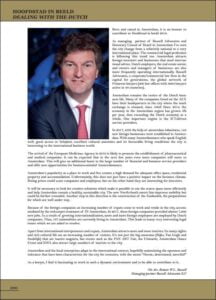 Reinier W.L. Russell, LL.M., managing partner of Russell Advocaten, has provided the column “Dealing with the Dutch” for the publication Parlementaire Agenda 2019. In addition to a calendar, this agenda contains information and many addresses that are of relevance for the political life in the Netherlands. Particular attention is always paid to the Dutch capital, Amsterdam.
In his contribution Reinier Russell deals with the reasons why Amsterdam is so attractive for international business, as can be seen from the increasing number of companies that set up business and expats who settle in the city.
The Parlementaire Agenda is sent to the members of the Royal Family, States-General, cabinet, Council of State and the Supreme Court, among others. It is also distributed amongst members of the staff and high officials, as well as executive officers from the industry and important representatives of the social partners.
Over the past year, the number of rental properties sold has risen sharply. Private residential landlords are pulling out due to stricter regulations and declining returns. For tenants, this creates uncertainty about their rights. Still, one reassuring rule applies: “Sale does not terminate the lease.”
The European Commission aims to introduce a new European legal entity in 2027: EU Inc. How does EU Inc. work? For which companies is this legal form suitable?
What can you do if you have a dispute with the board or the manager of the homeowners’ association? For example, regarding overdue maintenance or whether sustainability measures are too expensive?
European regulatory developments are introducing major new obligations for companies in the retail, fashion and luxury sectors. Companies must prepare their compliance processes accordingly.
When is a director still permitted to participate in decision-making if they have a personal conflict of interest regarding a decision? And who is authorised to make that judgement?
On 2 June 2026, the Dutch Senate adopted the Digital General Meeting for Private Law Legal Entities Act. This Act makes it possible to hold general meetings entirely digitally. What does this mean for directors and shareholders of private limited companies, public limited companies and other legal entities?
