


Reinier advises national and international companies
reinier.russell@russell.nl +31 20 301 55 55On 19 September, a large number of corporate counsels visited Russell Advocaten for the seminar “Latest Developments in International Commercial Litigation”. The seminar was organised by Russell Advocaten in cooperation with the international lawyers’ network Primerus and ACC Europe.
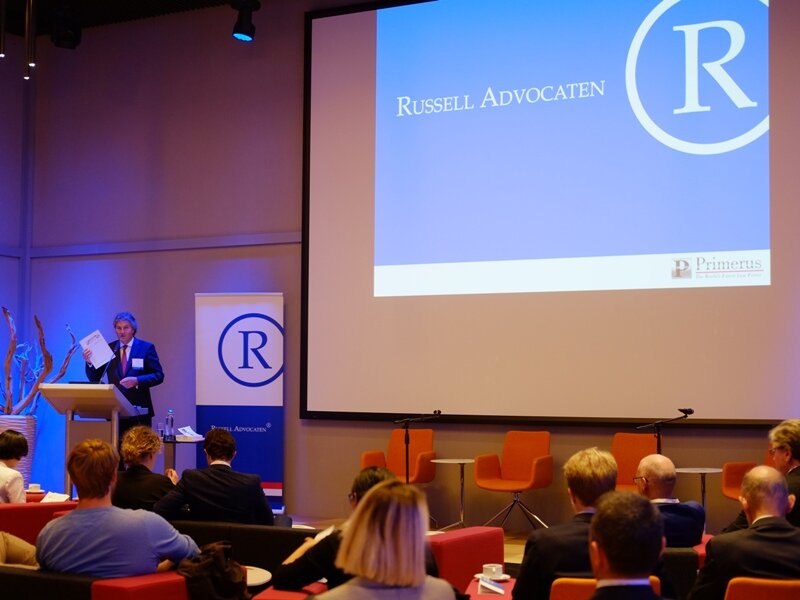
On 19 September, a large number of corporate counsels visited Russell Advocaten for the seminar “Latest Developments in International Commercial Litigation”. The seminar was organised by Russell Advocaten in cooperation with Primerus, an international network of 160 top-rated, independent law firms in 40 countries, and ACC Europe.
After the opening by managing partner Reinier W.L. Russell, Dr. R.J.Q. Klomp, Deputy Judge of the Amsterdam Court of Appeal, talked about the Netherlands Commercial Court, which started in January of this year. This makes it possible to litigate in English in international business disputes in the Netherlands. Brian Wagner of the Primerus law firm Mateer Harbert, P.A., Orlando, Florida, discussed the possibility of using U.S. discovery laws in procedures outside the United States as well. An attractive option as it allows more information to be requested than is allowed in most other countries.
After a short break there was a discussion with a panel consisting of Martijn Aardema of Crowd Strike and the Primerus lawyers Ahmet Berker (Istanbul, Turkey), Prof. Dr. Alberto Malatesta (Milan, Italy) and Michael W. Kiernan (Cherry Hill, New Jersey, USA). Topics discussed included the duration of proceedings, the appointment of judges and the ability to recover debts in different countries.
ACC Europe, Primerus and Russell Advocaten can look back on a very successful congress. The corporate counsels at the seminar were provided with the necessary means to effectively address international business disputes.
What options do employers have when (international) employees (do not) return to work? This and other Covid-19 related employment issues will be addressed at a webinar co-hosted by Russell Advocaten in cooperation with the Association of Corporate Counsel Europe and Primerus EMEA on Wednesday 16 September, 11.00 – 12.00h CEST.
When a debtor refuses to pay despite reminders and demand letters, stronger measures will be necessary to secure a claim. One of the most effective instruments in Dutch debt recovery is attachment. How can a creditor secure such an attachment?
Under the Money Laundering and Terrorist Financing (Prevention) Act (Wwft), banks may be obliged to refuse a customer or terminate their relationship with them. This can also happen to charities. When is a bank permitted to terminate the relationship? And must a customer cooperate with a bank’s investigation?
Most business relationships run smoothly. Goods are delivered, services are provided and invoices are paid on time. Occasionally, however, a customer or business partner fails to pay. What can a creditor do in that situation?
As of 1 January 2026, the Money Laundering and Terrorist Financing (Prevention) Act (Wwft) will change. Cash payments of EUR 3,000 or more will then be prohibited. What does this mean for the retail sector and the art trade?
Managing a nonprofit organization requires not only idealism and dedication, but also a sensible approach to legal opportunities and risks. This ensures that the charity is future-proof. What are the important issues that need to be properly addressed?
